
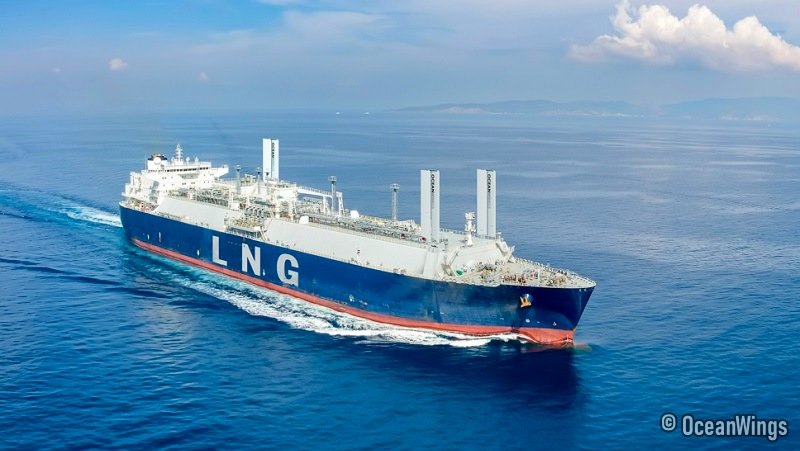
Paris, France | October 1, 2025 – At the high-profile GasTech 2025 exhibition, a significant milestone in maritime decarbonization was reached as Everllence, ABB, and OceanWings signed a Memorandum of Understanding (MoU). The tripartite agreement aims to pioneer an integrated sustainable propulsion concept that merges advanced wind-assisted technology with hybrid electric systems, specifically targeting the high-performance requirements of the LNG carrier segment.
The Synergy: DFE+ Meets Wind-Assisted Propulsion (WAPS)
The core of this collaboration is the integration of OceanWings’ rigid wingsail technology with the DFE+ (Dual-Fuel Electric+) concept, a variable-speed diesel-electric system co-developed by Everllence and ABB.
The DFE+ system is engineered for maximum efficiency across the entire load range. Unlike traditional constant-speed engines that lose efficiency at partial loads, the DFE+ system utilizes ABB’s Dynamic AC (DAC) power distribution and Everllence’s 49/60DF four-stroke engines. This allows for:
- High Efficiency at Low Loads: Optimal engine speed is maintained even when power demand is low.
- Modular Flexibility: Multiple engines allow for precise power management, reducing fuel consumption and “methane slip.”
- Future-Proofing: The architecture is designed to seamlessly integrate batteries and fuel cells as they reach commercial maturity.
Industry Leadership: Executive Perspectives
The partnership brings together three distinct areas of expertise: engine manufacturing, electrical automation, and aerodynamic propulsion.
Rune Lysebo, Head of Strategic Market Development at ABB’s Marine and Ports division, emphasized the importance of the electrical “backbone” in this setup:
“We at ABB believe that the flexibility of our hybrid electrical propulsion system is a good match with the variable power contribution from the wind. By utilizing ABB’s advanced power and energy solution, we are able to optimize the operational efficiency of the vessel.”
Romain Grandsart, COO of OceanWings, highlighted the operational fit for the gas sector:
“LNG carriers sail fast and spend typically 70% of their time at sea. This is ideal for harnessing wind and the full potential of OceanWings rigid wingsails. Combined with optimized propulsion, including a DFE+ highly efficient variable speed concept engine, this unlocks double-digit fuel savings and GHG emission reduction, all being compatible with the boil-off gas management.”
Dominik Thoma, Global Manager LNG Cargo at Everllence, addressed the technical challenge of intermittency:
“While WAPS introduces highly variable propulsion demand due to fluctuating wind conditions, DFE+ propulsion offers precise load control and operational flexibility, making it exceptionally well-suited to harness the variable and intermittent power contributions of wind-assisted systems. In combination with smart power-management systems and adaptive trimming, we see significant potential for reduced emissions and OPEX.”
Technical Deep-Dive: Overcoming the Intermittency Challenge
One of the primary hurdles in wind-assisted shipping is the variable nature of wind power. OceanWings’ Adaptive Trimming capability continuously adjusts the wingsails’ positioning, accounting for the vessel’s unique aerodynamic profile.
When wind conditions are favorable, the wingsails provide a “free” boost to propulsion. However, this creates a fluctuating load on the ship’s engines. The DFE+ system solves this by using variable-speed engines that can instantly adjust their output to compensate for the wind’s contribution, ensuring that the total power delivered to the propellers remains stable while fuel consumption is minimized.
Strategic Impact and Future Scope
The collaboration is not limited to environmental gains; it also focuses on improving the bottom line for shipowners by delivering:
- Reduced CAPEX and OPEX: Streamlined designs and lower fuel consumption contribute to a faster return on investment (ROI).
- Increased Cargo Capacity: Optimizing the engine room footprint and machinery space allows for more cargo volume.
- Regulatory Compliance: The system is designed to exceed current IMO and EU emission standards well into 2035.
While the initial focus is on a next-generation LNG carrier concept, the partners intend to scale this technology for the broader cargo segment, particularly for long-distance vessels with sufficient deck space to accommodate wingsails and propulsion systems requiring high flexibility.
Technical Spotlight: Who is OceanWings?
OceanWings is a French maritime technology pioneer specializing in automated, reefable, and retractable wingsails. While wind propulsion is an ancient concept, OceanWings has modernized it into a high-tech “propulsion-as-a-service” solution that treats wind as a predictable, high-performance fuel source.
Elite Heritage: From America’s Cup to Commercial Cargo
The technology behind OceanWings wasn’t born in a lab; it was born on the racetrack. The concept was developed by VPLP Design, the world-renowned naval architects responsible for the wingsail that propelled BMW Oracle Racing to victory in the 2010 America’s Cup.
Unlike “soft” sails, these are rigid, two-element foils—similar to an airplane wing, that generate significantly more lift and thrust. OceanWings successfully industrialised this high-speed racing tech into a robust, “marinized” version capable of surviving decades in the harsh conditions of the open ocean.
The “Smart” Sail: Automation & AI
For modern bunkering and shipping operations, “simplicity” is key. OceanWings are 100% automated, meaning they require no specialized crew.
- Adaptive Trimming: The system uses AI and machine learning to sense the wind and adjust the wings’ angle of attack and camber (curve) in real-time.
- Reefable and Retractable: In extreme weather or for port clearance (Air Draft), the wingsails can be lowered or folded, ensuring they never interfere with cargo operations or safety.
Proven Performance & Fuel Savings
OceanWings is one of the few WAPS (Wind-Assisted Propulsion Systems) providers with multi-year, large-scale operational data.
- The Canopée Success: The 121-meter Ro-Ro vessel Canopée (which transports Ariane 6 rocket components) is equipped with four OceanWings. Over two years of operation, it has maintained 99.6% system availability.
- Bunker Savings: Data from the Canopée shows average fuel savings of 1.3 tonnes per day, per wingsail. On optimized routes, savings can reach up to 2.2 tonnes per day, per sail, representing a double-digit reduction in the vessel’s total fuel spend.
- Range: Depending on the route and vessel type (Tanker, Bulker, or Gas Carrier), OceanWings can reduce CO2 emissions and fuel costs by 15% to 50%.
Source: OceanWings