October 13, 2025 – As regulatory pressure intensifies and onboard energy costs continue to rise, shipowners are increasingly turning to retrofits and engine upgrades as a commercially realistic alternative to expensive newbuild investments. According to WinGD, one of the world’s leading marine engine designers, well-planned retrofit programmes can extend the compliant trading life of existing vessels by many years, while delivering immediate efficiency and fuel cost benefits.
The timing is critical. With the IMO’s carbon intensity regulations tightening and regional measures such as the EU ETS and FuelEU Maritime adding direct cost exposure, shipowners face growing uncertainty over how to maintain competitiveness across aging fleets. The challenge is amplified by a simple reality: most of the vessels that will be trading in 2030, and even 2040, are already in operation today.
Decarbonisation Runs Through the Existing Fleet
“While newbuilds will always attract the headlines, the reality is that the path to net zero runs through the ships already in service,” said René Baart, Head of Retrofit Solutions at WinGD. “Retrofits give shipowners the flexibility to reduce emissions, improve efficiency and extend the value of their assets today, not years from now.”
From a fuel industry perspective, this trend has direct implications for fuel demand patterns, bunker specifications, and infrastructure planning. Rather than waiting for a future fleet dominated by new alternative-fuel vessels, shipowners are increasingly opting for incremental upgrades that allow them to adapt to evolving fuel availability and pricing dynamics.
Beyond Compliance: A Strategic Investment Decision
WinGD stresses that retrofit decisions are no longer just about regulatory compliance. Instead, they represent a broader strategic choice aimed at controlling lifecycle costs, stabilising operating expenses, and preserving asset value in an increasingly volatile market.
“With compliance costs increasingly challenging the profitability of older vessels, a well-timed retrofit can keep a vessel in viable service for longer,” Baart explained. “A retrofit programme can also bring operational certainty by minimising off-hire time while delivering predictable efficiency gains.”
For bunker buyers, these upgrades often translate into lower specific fuel consumption, improved flexibility in fuel choice, and greater resilience against future carbon pricing mechanisms.
Retrofit Options: From Alternative Fuels to Digital Optimisation
Unlike newbuilds, existing vessels must contend with legacy machinery and design constraints. As a result, retrofit strategies are typically tailored vessel by vessel, depending on age, trading pattern, machinery configuration, drydock schedules, and fuel availability.
WinGD highlights a wide range of upgrade pathways, including:
- Conversion of engines to operate on LNG, methanol or ammonia
- Engine hardware and control system upgrades
- Emissions abatement system installations
- Engine derating and advanced tuning solutions
- Hybrid power and energy management systems
- Digital optimisation and condition-monitoring platforms
- Reliability upgrades to support long-term operation
Dual-Fuel Conversions Gain Momentum
Among the most visible retrofit trends is the conversion of diesel engines to dual-fuel operation, particularly LNG, with methanol and ammonia increasingly under evaluation.
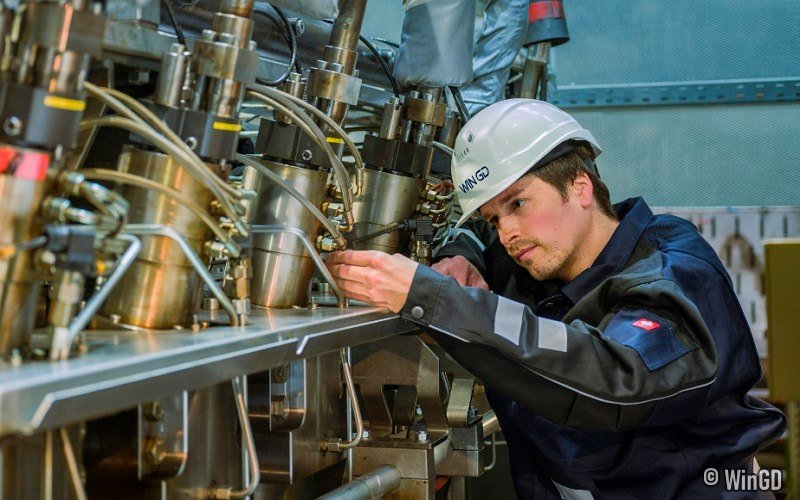
WinGD’s X and X-DF engine platforms were designed with fuel adaptability in mind, enabling conversions that include cylinder head replacements, new fuel injection systems, and control system modifications.
“Infrastructure and fuel availability are evolving at different speeds around the world,” Baart noted. “By converting vessels today, shipowners can secure compliance and cost advantages immediately while positioning themselves for future fuel adoption.”
A diesel-to-LNG conversion can typically be completed within approximately three months, with additional enhancements such as intelligent control by exhaust recycling (iCER) and variable compression ratio (VCR) technology delivering further emissions reductions. Even minor upgrades—such as installing a filler gasket between the cylinder cover and liner—can reduce methane slip by up to 0.2 g/kWh with minimal installation time.
Efficiency Upgrades for Conventional Fuel Users
Not all vessels are candidates for alternative fuel conversion, particularly in trades where fuel availability remains limited. For these ships, efficiency-focused retrofits continue to play a critical role.
Technologies such as Automated Sequential Turbocharging (aSTC) can reduce fuel consumption at part loads by up to 5 g/kWh, while engine derating and advanced diesel tuning improve EEXI and CII ratings. Intelligent Combustion Control systems dynamically adjust injection and valve timing in response to ambient conditions, cutting fuel burn while reducing engine wear.
From a bunker market standpoint, these upgrades support lower overall fuel demand per voyage, reinforcing the shift toward efficiency rather than simple fuel switching.
Digitalisation and Lifecycle Support
Digital optimisation is also becoming central to retrofit strategies. WinGD’s WiDE digital platform offers real-time diagnostics, predictive maintenance, and performance optimisation tools that help crews and operators make data-driven decisions, reduce unplanned downtime, and extend engine life.
Equally important is aftermarket support. WinGD emphasises that successful retrofit projects depend on OEM expertise, global service coverage, and genuine parts availability, particularly as demand for retrofit capacity increases ahead of regulatory deadlines.
“There is not infinite capacity,” Baart said. “As compliance milestones approach, there will be increasing competition for retrofit slots.”
A Commercial Bridge to the Future
For shipowners navigating regulatory uncertainty, volatile fuel prices, and capital constraints, retrofits are increasingly viewed as a commercially sensible bridge to a lower-carbon future.
“Shipowners who act early not only gain compliance and emissions benefits,” Baart concluded, “they also reduce operating costs and secure long-term value from their assets. Retrofits are not a stop-gap, they are a proven pathway to sustainable shipping.”
For the global bunkering and marine fuels sector, this shift underscores a clear message: the energy transition will be driven as much by upgrades to today’s fleet as by the fuels of tomorrow.
WinGD in Brief
WinGD (Winterthur Gas & Diesel) is a Swiss marine power company that designs two-stroke low-speed engines for merchant shipping. Originating as the Sulzer Diesel Engine business in 1893, WinGD today focuses on advancing the decarbonization of marine transportation through sustainable energy systems. Its core product, the X-DF dual-fuel engine, is central to the industry’s shift toward LNG and future low-carbon fuels. The company provides tailored 24/7 lifecycle engine support through Global Service by WinGD.
Source: WinGD