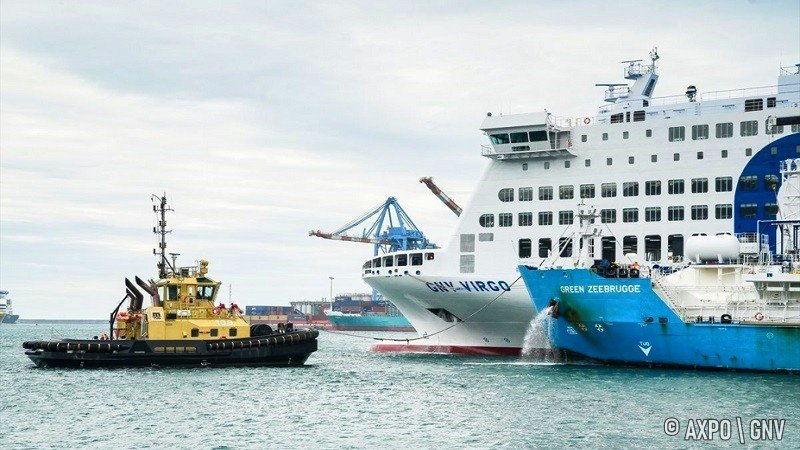
GENOA, ITALY | December 4, 2025 – A defining moment for the decarbonization of the Mediterranean ferry sector has been achieved as Axpo, in partnership with Italian ferry operator GNV (MSC Group), successfully completed first ship-to-ship (STS) bunkering operation using Bio-LNG at the Port of Genoa. This landmark supply of a renewable fuel immediately launches the new flagship ferry, GNV Virgo, into service with a near-zero emission profile.
The meticulously planned STS bunkering operation involved the transfer of 500 cbm of certified Bio-LNG, a renewable gas produced from organic waste materials – to the dual-fuel GNV Virgo. This strategic bio-LNG supply fully fuels the vessel for its inaugural return voyage on the key Genoa–Palermo route, demonstrating the technical possibility of immediate maritime operations with net-zero greenhouse gas emissions, thereby anticipating the EU’s long-term aim to be carbon-neutral by 2050.
Pioneering a New Frontier in Marine Fuel
The GNV Virgo is the first Italian long-distance Ro-Pax vessel powered by liquefied natural gas (LNG) to be used on a regular route. The decision to use Bio-LNG, a renewable version of LNG, underscores the immediate possibility of achieving higher decarbonization targets.
GNV Chief Executive Officer Matteo Catani stated: “This moment represents a true turning point for GNV in reducing the environmental impact of our fleet. The introduction of LNG into our daily operations not only significantly lowers emissions, but also allows us to gain hands-on experience with the technologies that will shape the future of European maritime transport, confirming our commitment to increasingly sustainable and competitive shipping.”
Collaboration Enables Historic Feat
The success of the complex six-hour bunkering operation was the result of extensive collaboration, conducted strictly according to current safety regulations and international guidelines.
Axpo Italia CEO Simone Demarchi highlighted the local significance: “We’re proud to be contributing to innovation and sustainability in maritime transport with GNV, that such an important development is taking place in Genoa, where Axpo’s 25-year presence in Italy began, makes that satisfaction even greater.“
The close teamwork between the private sector partners was critically supported by the Maritime Authority of Genoa, the Western Ligurian Port Authority, and the Genoa Harbour Master’s Office, confirming the Port of Genoa’s readiness to support advanced, clean fuel innovations.
The Challenges of Supply and Investment
While celebrating the operational milestone, GNV addressed the necessary steps required to make Bio-LNG a long-term solution.
Matteo Catani added: “We are working to make the use of bio-LNG a structural solution for our operations. We are aware that, at present, the availability of this fuel remains limited and requires significant investments, as well as the development of a supply chain capable of ensuring stable, large-scale provision. Costs are still high and the quantity available on the market is not sufficient to meet growing demand. It is a complex journey that requires the commitment and collaboration of all stakeholders in the sector.”
Axpo’s Head of Small-Scale LNG Daniele Corti affirmed: “This operation demonstrates our determination to pioneer sustainable LNG solutions across the Mediterranean market. Bio-LNG is essential to achieving global emissions targets while advancing a cleaner, more sustainable future for marine logistics.“
GNV Virgo: A Leader Engineered for Green Shipping
The GNV Virgo is the standard-bearer for GNV’s massive fleet renewal plan, which will see a total of eight new LNG units join the fleet by 2030.
- Timely Delivery: The vessel was delivered ahead of schedule in October, 2025, following successful sea trials in August, 2025.
- Capacity and Speed: The 52,300-ton Ro-Pax is 218 metres long, can accommodate up to 1,785 passengers, and has a cargo capacity of 2,770 linear metres, reaching a maximum speed of 25 knots.
- Advanced Technology: The dual-fuel ship’s design guarantees a reduction in CO₂ emissions of over 50% per transportable unit and is equipped for cold ironing (shore power connection) to eliminate local emissions while docked.
Bio-LNG: Renewable Fuel Driving Net-Zero Operations
The bio-LNG fuel used in the bunkering is a fully renewable LNG variant with a strong decarbonisation profile. By using this fuel, GNV Virgo achieved net-zero emissions on its maiden Genoa–Palermo voyage, offering a tangible demonstration of how green fuels can be integrated into regular passenger ferry services.
The operation highlights the feasibility of scaling low-carbon fuels in Mediterranean ports, setting a precedent for future green maritime initiatives across Italy and Europe.
A Historic Milestone for Genoa and Italian Shipping
This first ship-to-ship Bio-LNG bunkering in Genoa represents a breakthrough for Italy’s maritime sector, combining cutting-edge technology, renewable fuels, and coordinated partnerships to achieve practical decarbonisation.
This achievement positions Genoa as a pioneering hub for low-carbon shipping in the Mediterranean, while reinforcing the importance of sustainable fuel supply chains, public-private cooperation, and forward-looking fleet strategies.
“GNV Virgo is just the beginning: by 2030, five more LNG-powered vessels will join the fleet, reflecting our commitment to an increasingly sustainable fleet.” Shared GNV.
About Axpo
Axpo is Switzerland’s largest producer of renewable energy and a leading player in energy trading and LNG solutions. Operating in over 30 countries across Europe, North America, and Asia, Axpo delivers innovative and sustainable energy solutions for a wide range of customers, from small enterprises to large industrial companies. In the maritime sector, Axpo is a trusted partner in LNG and bio-LNG bunkering, committed to accelerating the decarbonization of shipping through clean fuel supply chains.
About GNV: Grandi Navi Veloci
Grandi Navi Veloci (GNV) is a leading European ferry company and a prominent member of the MSC Group. GNV operates an extensive network of maritime connections, serving as a critical transportation link for passengers, vehicles, and freight across the Mediterranean. GNV operates on a robust network of 33 maritime routes connecting key destinations across Southern Europe and North Africa.
The company’s routes link Italy (including the islands of Sardinia and Sicily), Tunisia, Algeria, Morocco, Spain, France, Albania, and Malta.
- Key Italian Ports: Genoa, Civitavecchia, Naples, Palermo, Termini Imerese, Olbia, and Porto Torres.
- International Ports: Barcelona, Valencia, Palma de Mallorca, Ibiza, Mahón, Almería, Tunis, Tangier, Algiers, Bejaia, Nador, Sète, Bari, Durrës, and Malta.
Focus on “Motorways of the Sea”
GNV is a primary developer and operator of the “Motorways of the Sea” concept. This initiative positions sea transport as a cost-effective and efficient alternative to traditional road transport, particularly for heavy lorry traffic. This innovative approach serves a dual purpose:
- Economic Efficiency: It helps reduce overall transportation costs for freight and logistics companies.
- Environmental Solution: It provides an efficient solution to the environmental challenges associated with heavy lorry traffic on national road networks by shifting freight volume from roads to less polluting sea lanes.
Source: GNV | AXPO