
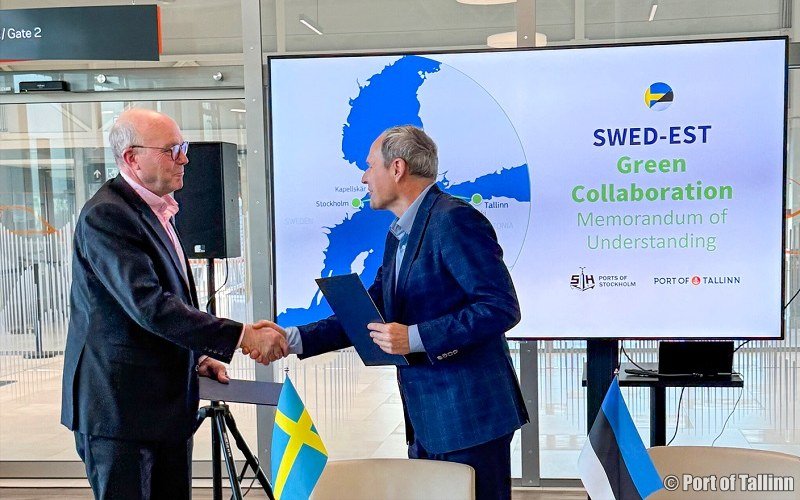
Tallinn, Estonia | November 4, 2025 – The Port of Tallinn and Ports of Stockholm have taken a significant stride toward sustainable maritime transport with the signing of a MoU in Tallinn. The agreement, which marks the launch of the Swed-Est Green Collaboration, is a joint initiative aimed at fostering fossil fuel-free and environmentally sustainable maritime operations between Estonia and Sweden. The initiative will initially focus on the key Tallinn–Stockholm and Paldiski–Kapellskär ferry routes.
Table of Contents
Driving a Green Maritime Future
According to Valdo Kalm, CEO of the Port of Tallinn, the collaboration is designed to reduce the environmental footprint of maritime transport while offering passengers and cargo operators long-term sustainable solutions.
“This partnership provides both ports with a strategic advantage, making us more attractive to shipowners, passengers, and cargo operators seeking sustainable travel and transport options. It also opens doors to developing new business models for fossil fuel-free maritime transport, joint research initiatives, and applications for EU and other funding programs,” Kalm said.
Beyond environmental benefits, the initiative is expected to enhance passenger volumes, cargo flows, and ship calls, contributing directly to regional economic growth and the prosperity of communities surrounding the ports.
Valdo Kalm also noted that while the Port of Tallinn and Ports of Stockholm are the primary drivers, private and public sector stakeholders, research institutions, and other maritime actors will be invited to join the collaboration in the future.
Shared Responsibility Across the Baltic Sea
Magdalena Bosson, CEO of Ports of Stockholm, emphasized the mutual responsibility shared by Sweden and Estonia to safeguard the Baltic Sea.
“Sweden and Estonia share the same sea and the same responsibility to protect it. By working together, we can accelerate the green transition across the Baltic Sea region, making maritime transport cleaner and more efficient,” Bosson said.
Key Goals and Initiatives
The MoU outlines a wide array of joint activities and targets across four ports, focusing on emission reduction, energy efficiency, and circular economy practices. A central objective is the installation of Onshore Power Supply (OPS) systems for ro-pax vessels at Paldiski South Harbour and the Port of Kapellskär by 2030. This will allow ships to connect to shore power while docked, significantly reducing CO₂ emissions and noise pollution.
Both ports are also investing in renewable energy solutions:
- The Port of Tallinn plans to transition to CO₂ emission-free heating and electricity systems at its D-Terminal in Old City Harbour and Paldiski South Harbour, alongside deploying solar panels, LED lighting, and other green technologies.
- Ports of Stockholm are exploring solar installations at Värtahamnen and Kapellskär and examining options for fast-charging infrastructure for buses, trucks, and heavy vehicles.
Enhancing Circular Economy and Waste Management
Waste management and circular economy practices form a core part of the collaboration:
- The Port of Tallinn intends to increase ship-generated waste recycling through improved sorting and handling.
- Ports of Stockholm are developing solutions for separating and processing food waste to produce biogas and reduce hydrogen sulfide in sewage treatment.
Both partners will also explore reusing treated greywater for applications such as quay flushing.
Transitioning to Zero-Emission Port Operations
A key goal is the adoption of energy-efficient, zero-emission port machinery and transport. The Port of Tallinn is moving toward fully energy-efficient and zero-emission equipment and promoting green taxis, public transport, and bicycle infrastructure. Ports of Stockholm are advancing a port truck strategy for zero-emission cargo handling at Kapellskär and expanding electrification at Värtahamnen to lower air and noise pollution.
Sustainable Terminal Modernisation
The collaboration also includes the modernisation of port terminals to meet high environmental standards. The Port of Tallinn will share expertise from the D-Terminal renovation and the new A-Terminal construction in Old City Harbour. Ports of Stockholm are upgrading Värtahamnen terminal in line with stringent sustainability requirements.
“We have already made substantial progress through our FIN-EST Green Corridor initiative with the Port of Helsinki and ferry companies, and we are pleased to extend that experience to our collaboration with the Ports of Stockholm,” Kalm added.
A New Era in Baltic Maritime Cooperation
The Swed-Est Green Collaboration represents a milestone in maritime cooperation between Estonia and Sweden, reflecting a shared commitment to a cleaner Baltic Sea and a sustainable environment. By integrating innovation, renewable energy, circular economy practices, and zero-emission operations, the Port of Tallinn and Ports of Stockholm aim to create a future-proof, environmentally conscious maritime network connecting the two countries.
The MoU was formally signed by Valdo Kalm, CEO of Port of Tallinn, and Anders Nordlund, Harbour Master of Ports of Stockholm.
The Ports of Stockholm
Ports of Stockholm is one of the world’s largest passenger ports and among Sweden’s leading freight ports, with strategic locations in Stockholm, Kapellskär, and Nynäshamn, at the heart of Sweden’s largest consumer region. The central Stockholm ports, Stadsgården and Värtahamnen, serve as key hubs for goods and passenger traffic to and from Finland and the Baltic States, while Frihamnen Port plays a vital role in international cruise traffic.
The outlying ports of Kapellskär (90 km north of Stockholm) and Nynäshamn (60 km south of Stockholm) provide short approach fairways and complement the central ports. Kapellskär is crucial for rapid freight transport to Finland and Estonia, whereas Nynäshamn serves as the mainland gateway to Gotland and central and southern Baltic ferry routes. Additionally, Stockholm Norvik Port, located just north of Nynäshamn, functions as a modern container and RoRo port with a prime position in the Baltic Sea.
The Port of Tallinn
Port of Tallinn is the largest port authority in Estonia, with a strategic mission to enhance the country’s competitiveness as a maritime nation. Listed on the Nasdaq Tallinn Stock Exchange since June 13, 2018, its ownership is divided between the Republic of Estonia (67%) and investment funds, pension funds, and private investors (33%).
Operating as a landlord port, Port of Tallinn focuses on maintaining and developing port infrastructure while leasing territories to terminal operators, who manage cargo handling and invest in superstructure and technology. Its activities span cargo operations, passenger services, real estate development, and shipping. The port comprises four harbours—Old City Harbour (including Old City Marina), Muuga Harbour, Paldiski South Harbour, and Saaremaa Harbour—and owns the Muuga (76 ha) and Paldiski South (34 ha) Industrial and Logistics Parks.
Source: Port of Tallinn