

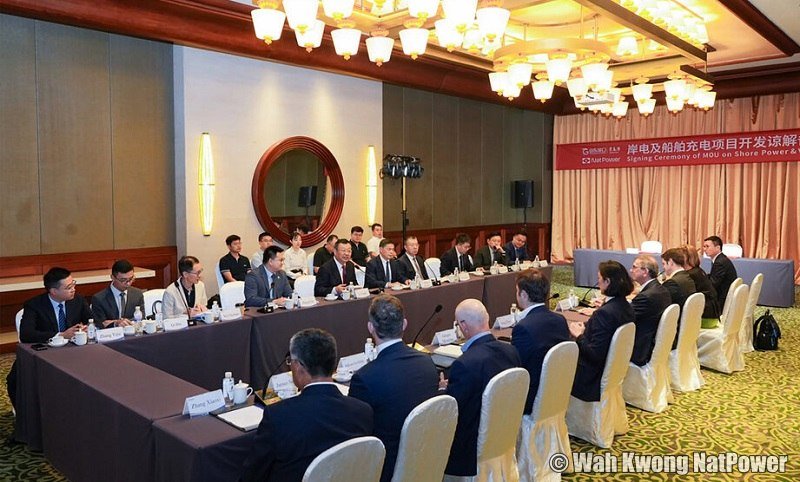
London, 15th September 2025 – In a defining moment for maritime sustainability and global shipping decarbonisation, Wah Kwong NatPower Holdings Limited (WK NatPower) and the Shandong Port Group (SPG)—the world’s largest and most technologically advanced port operator—have signed a landmark Memorandum of Understanding (MOU) to develop and implement large-scale shore power and ship charging infrastructure across critical global trade routes.
This strategic partnership marks a significant acceleration in the maritime energy transition and directly supports the creation of global green shipping corridors, with a particular focus on the Asia-Europe maritime bridge.
Electrifying the Future of Global Shipping
At the heart of this MOU is a shared vision to electrify vessels at scale, reduce reliance on fossil fuels both at berth and at sea, and deliver innovative, commercially viable decarbonisation pathways for international shipping fleets.
The collaboration will begin at Qingdao Port International Co., Ltd., one of the world’s most automated and efficient container terminals, where both partners will explore new models for electric vessel operations. This includes not only the expansion of cold ironing systems—allowing ships to plug into shore power while docked—but also the development of high-capacity ship propulsion charging infrastructure.
By leveraging Qingdao’s deep operational experience and WK NatPower’s renewable energy expertise, the partnership aims to create a blueprint for clean port infrastructure that can be replicated at scale across Hong Kong, Mainland China, and eventually throughout Europe.
Integrated Global Shore Power Network
The agreement includes the deployment of an integrated shore power services network, delivering one-stop solutions for international shipping clients. This will connect SPG’s extensive port network to WK NatPower’s growing portfolio of clean infrastructure projects, facilitating seamless energy access and dramatically cutting emissions across the shipping supply chain.
Both partners will also jointly promote the export and application of these clean energy solutions, laying the foundation for the first interconnected, international green shipping corridors linking Asia with Europe—a crucial step toward decarbonising global trade.
Driving the Maritime Energy Transition: Leadership Viewpoints
“The strategic alliance with Qingdao Port is a major step in decarbonising global supply chains. By integrating our expertise and networks, we are building an ecosystem for green shipping and providing the industry with solutions towards net zero,” Said Vincent Ni, General Manager of WK NatPower
“This partnership with Shandong Port Group marks a pivotal moment in the journey to decarbonise global shipping. By combining NatPower’s international expertise with SPG’s leadership and scale, we are not only advancing shore power and electric propulsion in China but also setting the foundations for global green corridors that connect Asia and Europe. Together, we are turning ambition into action and creating the infrastructure that will power the next era of sustainable shipping,” Said Stefano D.M. Sommadossi, CEO, NatPower Marine UK and Joint Director, Wah Kwong NatPower Holding
“This agreement strengthens our partnership and allows us to expand our cooperation in green energy. It is our shared vision to develop green port infrastructure and reduce emissions in shipping, which is central to establishing Qingdao as a leading international shipping centre,” Said Zhang Baohua, General Manager, Qingdao Port International Co., Ltd.
A Milestone for Maritime Decarbonisation
This MOU represents far more than a bilateral agreement—it is a blueprint for the future of sustainable maritime trade. By aligning China’s most advanced port infrastructure with a global clean energy strategy, WK NatPower and SPG are not only enabling low-emission logistics but also reinforcing their leadership in the global green energy transition.
With the shipping industry responsible for nearly 3% of global carbon emissions, such transformative collaborations are essential. This agreement is poised to become a reference model for how public-private cooperation, innovation, and shared purpose can reshape maritime infrastructure for a zero-carbon future.
Shandong Port Group (SPG)
As the world’s largest and most technologically advanced port conglomerate, SPG operates across key hubs including Qingdao, Rizhao, Yantai, and Weihai. It is a global leader in port digitization, logistics integration, and port energy transformation. SPG plays a central role in facilitating China’s Belt and Road Initiative and the development of green and smart port ecosystems, making it a pivotal force in shaping the future of maritime commerce.
Qingdao Port International Co., Ltd
Established in 2013 and listed in both Hong Kong and Shanghai, Qingdao Port International is the flagship operator of the historic Port of Qingdao, which dates back to 1892. The port handles a vast range of cargo types, from containers and metal ore to crude oil and coal. It is globally recognized for its automation, scale, and efficiency, and serves as a major strategic node in Northeast Asia’s shipping network. Qingdao Port is a pioneer in port electrification and smart logistics innovation.
Wah Kwong NatPower Holdings Limited (WK NatPower)
WK NatPower is a strategic joint venture between Hong Kong’s Wah Kwong Maritime Transport and international clean energy company NatPower. The company brings together deep-rooted maritime heritage with leading-edge renewable energy development. WK NatPower is focused on investing in, developing, and operating an integrated maritime electrification infrastructure across Asia and beyond, including cold ironing and propulsion charging solutions, with the goal of powering the transition to zero-emission shipping.
Source Wah Kwong NatPower Holdings Limited