
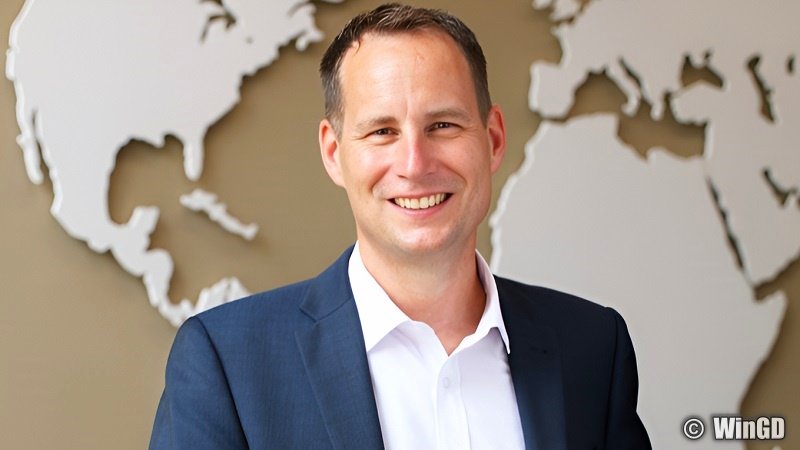
August 18, 2025 – Winterthur, Switzerland – In a decisive call to action, Dominik Schneiter, CEO of WinGD Ltd., has urged the International Maritime Organization (IMO) to provide clearer and more timely incentives for the industry’s transition to net zero. While the IMO’s newly proposed Net Zero Framework (NZF) sets out an ambitious global path toward decarbonisation by 2050, industry leaders like WinGD warn that delays in critical decisions could derail progress before it even begins.
The NZF, hailed as a landmark in global climate regulation, is the first framework to pair mandatory emissions targets with a greenhouse gas (GHG) pricing mechanism across an entire industrial sector. It introduces a GHG Fuel Intensity (GFI) standard, aimed at encouraging early adoption of zero and near-zero (ZNZ) emission energy sources. However, according to Schneiter, the real impact of the framework hinges on more than its ambition—it depends on execution.
“Without strong incentives and clearer rules, the decarbonisation course risks drifting,” said Dominik Schneiter, CEO of WinGD “This is a pivotal moment. If we want to build a truly sustainable shipping industry, clarity can’t wait until 2027.”
Delayed Pricing Undermines Confidence
One of WinGD’s key concerns lies in the unfinalised pricing mechanism for vessels using ZNZ fuels. As it stands, the reward for clean fuel use is not expected to be disclosed until March 1, 2027—just nine months before the rules come into effect.
“This creates a blind spot for shipowners,” Schneiter explained. “Investments in compliant vessels and new fuel infrastructure require long-term planning. If the incentive is unclear—or worse, undervalued—operators may choose to ‘pay to pollute’ instead.”
WinGD is calling for immediate action to define the value or formula behind the clean fuel reward, arguing that energy providers need adequate time to scale up ZNZ fuel production and shipping companies need clarity to guide their multi-decade investment strategies.
Outdated Emissions Factors Block Innovation
Another major challenge is the framework’s reliance on default emission factors rather than actual, measured emissions. These factors, while convenient, often reflect outdated values that fail to account for rapid advances in engine and fuel technologies.
Take the example of methane slip—unburned methane released from LNG engines. The default slip rate applied to Otto-cycle slow-speed dual-fuel engines, including WinGD’s advanced X-DF models, is based on technology introduced over a decade ago. Today’s engines have reduced methane slip by 53–70%, yet operators can only benefit from these improvements if they undergo complex emissions measurement, certification, and verification procedures.
“This adds an unnecessary burden and penalizes innovation,” Schneiter said. “We should be incentivising the adoption of new technologies, not making it harder.”
The Emissions Intensity Trap
WinGD also highlighted a deeper flaw in the way emissions penalties are calculated—through intensity metrics, rather than overall emissions. In a case modelled by the company, an engine that used less fuel and emitted fewer total GHGs was penalised more heavily than a less efficient setup, simply because of how the emissions-per-fuel-unit ratio was calculated.
“This kind of distortion opens the door to greenwashing accusations,” Schneiter said. “It undermines trust and discourages meaningful action.”
A Framework Full of Potential—But Running Out of Time
Despite its shortcomings, WinGD remains a strong supporter of the IMO’s Net Zero Framework, viewing it as a necessary and visionary step toward decarbonisation. But the company stresses that for the framework to succeed, the reward structure must be finalised well ahead of 2027, and emissions accounting must evolve to reflect real-world performance and innovation.
“The IMO’s NZF is an opportunity for shipping to lead the fight against climate change,” Schneiter concluded. “But without sharper signals, sooner, that opportunity risks slipping away.”
About WinGD
With roots tracing back to Sulzer Diesel Engine in 1893, WinGD (Winterthur Gas & Diesel Ltd.) has evolved into a leading force in maritime propulsion innovation. Headquartered in Winterthur, Switzerland, the company is at the forefront of sustainable engine design, leveraging advancements in hybridisation, digital optimisation, emissions control, and fuel flexibility.
Backed by its global “Service by WinGD” network, the company provides 24/7 lifecycle support, genuine parts, and Swiss-engineered precision to ensure vessel performance remains optimised and compliant with evolving environmental standards.
Source WinGD (Winterthur Gas & Diesel Ltd)