
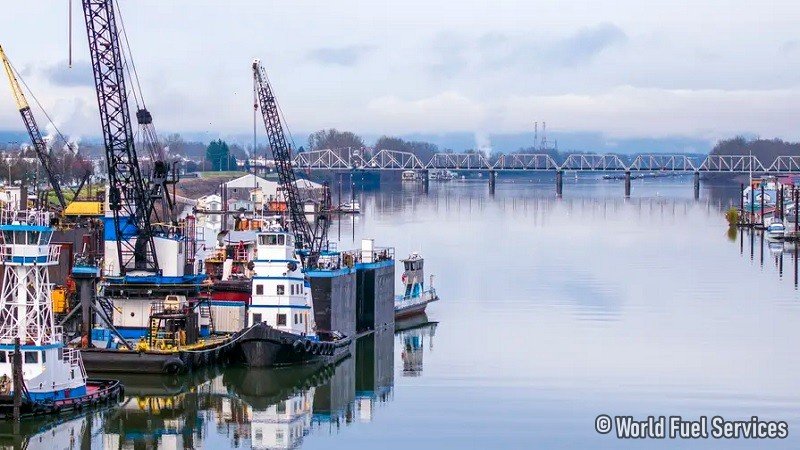
Portland, Vancouver | September 29, 2025 – In a move that significantly alters the bunker landscape of the Pacific Northwest, World Fuel Services (WFS) has officially reactivated its physical bunker supply operations on the Columbia River. This restoration ends a five-year period where deep-draft vessels calling at Portland, Vancouver (WA), and Longview were forced to undergo costly deviations to Puget Sound or California for fuel oil.
Table of Contents
The Strategic Necessity: Ending the “Port Angeles Deviation”
Since approximately 2020, the Columbia River, the United States’ top wheat export gateway and a premier auto-carrier hub, lacked a large-scale fuel oil barge.
- The Conflict: Outbound grain vessels and car carriers heading to Asia were forced to sail a full day (approximately 24 hours) north to Port Angeles or Victoria just to refuel.
- The Cost: These deviations incurred significant expenses in additional VLSFO/MGO consumption, increased crew fatigue, and complex voyage planning across the turbulent Gulf of Alaska.
- The Solution: By placing a dedicated barge back on the river, WFS has restored the “full-service” status of Portland, allowing vessels to bunker while at berth or at anchorages between Astoria and Portland.
Infrastructure & Supply Chain Control
WFS has opted for a closed-loop, highly controlled supply chain to ensure ISO 8217:2017/2024 compliance and mitigate contamination risks, a critical factor given the region’s distance from major refining centers.
Dedicated Terminal Operations
WFS operates its own private fuel oil terminal in Portland. Unlike “common user” facilities, this site is used exclusively by World Fuel, featuring:
- On-site Storage: Segregated tankage for high-sulfur, low-sulfur, and distillate grades.
- Quality Assurance: By controlling the dock and the tank farm, WFS maintains a “shore-to-ship” chain of custody, ensuring no intermingling of product through shared pipelines.
Exclusive Barge Assets
In partnership with Centerline Logistics (recently acquired by Maritime Partners), WFS has time-chartered a dedicated, double-hull bunker barge for exclusive use on the river.
- Operational Reach: The barge covers the entire 100-mile stretch from the Astoria entrance to the upper-river berths in Portland and Vancouver.
- Safety Standards: Utilizing Centerline’s Tier-3/Tier-4 tugs and experienced crews ensures compliance with stringent West Coast environmental regulations.
Technical Specifications & Product Slate
The Portland operation provides a comprehensive suite of marine fuels to accommodate both scrubber-fitted and non-scrubber vessels:
| Fuel Grade | Specification | Availability |
| VLSFO | 0.50% Sulfur | Immediate / Physical |
| HSFO | 3.50% Sulfur | Immediate / Physical |
| LSMGO | 0.10% Sulfur | Immediate / Physical |
| Renewables | B20/B30 Blends | Planned for Q4 2025/2026 |

Future-Proofing: WFS has confirmed it is currently integrating renewable diesel and biofuel blends into the Portland terminal. This aligns with the Port of Portland’s Clean Fuel Standards and the growing demand for FuelEU Maritime and IMO GHG compliance options for trans-Pacific routes.
Operational Precision in a River Environment and Local Expertise
The Columbia River presents unique scheduling hurdles. Vessels often arrive in Astoria requiring hold cleaning or inspections before they can proceed to berth. To address this, World Fuel has deployed a mix of local on-the-ground experience and centralized coordination.
- Local Coordination: Schedulers and operations staff are based locally, working in close contact with Merchant Exchange of Portland – agents to meet vessels at the right location without delay.
- Trading Support: While West Coast logistics are handled by Jared Kuebler’s team, global trading and financial coordination are managed from World Fuel’s New Jersey hub.
- Strategic Partnerships: The operation is bolstered by a partnership with Centerline Logistics. “They’re a mainstay on the West Coast, safe, efficient, and deeply experienced,” notes Kuebler. World Fuel is also an active member of the local Merchant Exchange.
- Timing: Vessels often require hold cleaning or USDA inspections in Astoria before moving to Portland. WFS schedulers coordinate barge movements to hit these “transition windows,” allowing ships to bunker without disrupting their narrow loading slots at the grain elevators.
- Risk Management: For owners concerned about West Coast price volatility, WFS is offering Fixed-Price Forward (FPF) contracts and financial hedging tools directly tied to the Portland physical supply.
The Bottom Line for the Industry
The reactivation of this service is more than a commercial expansion; it is a restoration of the Columbia River’s competitive standing in the Pacific trade. For the maritime community, this means shorter turnaround times, lower carbon footprints per voyage (by eliminating deviations), and a reliable, high-quality fuel source in a historically underserved region.
Restoring the Trade Corridor
Located 100 miles inland, Portland remains a bustling gateway for international trade, particularly between the Pacific Northwest and Asia. The river supports a complex mix of commercial vessels, including bulk timber carriers, container ships, and product tankers.
For approximately five years, the river lacked a dedicated barge capable of supplying fuel oil products. This forced vessels calling at Astoria, Portland, Vancouver, and Longview to sail a full day north to Port Angeles just to refuel, a detour that added significant time, fuel consumption, and complexity to trans-Pacific voyage planning.
“From Astoria to Portland, and every berth and anchorage in between, is covered,” says Jared Kuebler, Marine Trader at World Fuel. “We now support shipping activities along the Columbia River ports with the availability of fuel oil bunkers.”
A Strategic Gap Filled
With no refineries in Oregon and no other marine fuel oil suppliers on the Columbia, World Fuel’s re-entry solves a critical service gap that impacted both local commerce and global shipping routes.
“We’re proud to have brought this service back,” says Jared. “It’s good for Portland, good for the Columbia River, and good for the customers we serve.”
Long-Term Planning and Sustainability
To help shipowners mitigate market volatility, World Fuel offers fixed-supply options and financial hedging tools. These allow operators to plan and lock in prices up to a year in advance, a critical advantage for vessels facing three-week crossings to Asia.
Looking forward, the company is preparing to offer renewable fuel options at the Portland terminal, aligning with the industry’s long-term sustainability goals and the specific needs of decarbonization-focused customers.
World Fuel Services (A World Kinect Company)
Headquartered in Miami, Florida, World Fuel Services is a World Kinect (NYSE: WKC) company. World Fuel Services is a globally trusted provider of comprehensive fueling solutions, operational services, technology, renewable energy, and other sustainability solutions. Through its expansive marine and aviation divisions, the company delivers liquid fuels and lubricants across an integrated global network, acting as a critical link between sustainable fuel producers and the maritime customers committed to decarbonisation.
Source: World Fuel Services