

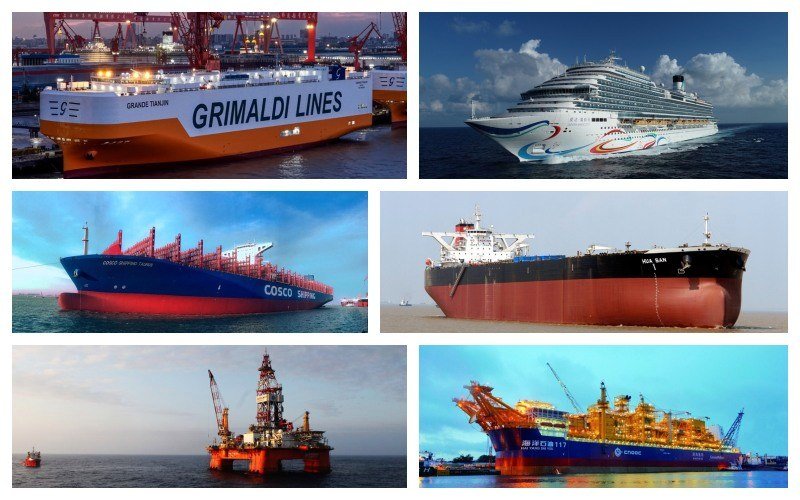
Shanghai, China – August 8, 2025 – Shanghai Waigaoqiao Shipbuilding Co., Ltd. (SWS), a subsidiary of China State Shipbuilding Corporation Limited (CSSC), has officially delivered its 600th vessel since its establishment, marking a significant milestone for China’s maritime industry. The vessel, named GRANDE TIANJIN, is a 9,000-car capacity Pure Car and Truck Carrier (PCTC) built for Italy’s Grimaldi Group—one of Europe’s leading Ro-Ro shipping operators.
This latest delivery reflects not only SWS’s technical capacity and production consistency, but also its increasingly central role in China’s emergence as a dominant force in the global shipbuilding sector. Since delivering its first vessel in 2003, SWS has now produced over 102 million deadweight tons (DWT), averaging 27 vessels or 4.6 million DWT annually.
Table of Contents
Six Centuries of Progress: A Strategic Growth Trajectory
The journey to 600 deliveries encapsulates more than two decades of targeted growth, technological evolution, and national strategic alignment. SWS has organized its progress into six key development phases—each reflecting a leap in capacity, capability, or global competitiveness.
- Phase I – Foundations (1–100 vessels): From 2003 to 2007, SWS focused on laying the industrial and design foundation with significant achievements including China’s first domestically designed Green Capesize bulk carrier and its first VLCC built to international CSR standards.
- Phase II – Scale and Standardization (101–200): By the early 2010s, SWS became a global leader in Capesize bulkers and VLCCs, playing a critical role in shifting perceptions from “Made in China” to “Designed in China.”
- Phase III – Offshore Expansion (201–300): With the delivery of Hai Yang Shi You 981, China’s first deepwater semi-submersible drilling rig, SWS stepped into the offshore engineering domain, supporting national energy security and deepwater ambitions.
- Phase IV – Resilience and Diversification (301–400): During the global shipbuilding downturn, SWS delivered its first 18,000 TEU ultra-large container ship and entered the VLGC market, positioning China as a serious contender against Japanese and Korean builders.
- Phase V – High-Tech Integration (401–500): Projects such as the intelligent 400,000-ton ore carrier Ming Yuan and the launch of China’s first large cruise ship program positioned SWS as a strategic player in the “high-end” segment.
- Phase VI – Leap and Leadership (501–600): Marked by the Adora Magic City cruise ship and dual-fuel, digitally managed bulk carriers, this phase demonstrates the successful execution of SWS’s “Cruise-led, Integrated Dual Wings” strategy, focused on diversification and clean energy innovation.
GRANDE TIANJIN: A Future-Proof, Green Maritime Asset
The GRANDE TIANJIN is more than a symbol—it’s a modern shipping platform tailored for the future of mobility and emissions control. Equipped with a high-efficiency, low-consumption main engine and advanced energy-saving features (including twisted rudder, bulb fins, and shore power systems), it meets the latest IMO environmental standards.
Notably, the vessel carries RINA’s “Ammonia Ready” certification, positioning it for potential future conversion to zero-carbon fuels. With a construction period of just 179 days, it also sets a new efficiency benchmark for PCTCs in its class.
On August 19, the vessel will embark on its maiden voyage to Europe, carrying Leapmotor’s one-millionth electric vehicle. This is part of the broader “Chinese Cars on Chinese Ships” strategy—linking the nation’s new energy vehicle (NEV) exports with its expanding maritime capabilities. It is a significant example of how shipbuilding and automotive sectors are integrating to form resilient, low-carbon export chains.
A Symbol of China’s Maritime Ambitions
With this milestone, SWS cements its role not only as a shipbuilder but as a strategic enabler of China’s maritime transformation. It remains the only shipyard globally capable of simultaneously constructing commercial ships, offshore engineering assets, and large cruise vessels.
As China advances into its 15th Five-Year Plan period, SWS is expected to play an increasingly pivotal role in green transformation, digital shipbuilding, and industrial chain integration. Its emphasis on intelligent design, high-efficiency production, and alternative fuel capabilities positions it at the forefront of the global shipbuilding renaissance.
About Shanghai Waigaoqiao Shipbuilding Co., Ltd. (SWS)
Founded in 1999, Shanghai Waigaoqiao Shipbuilding Co., Ltd. (SWS) is a wholly-owned subsidiary of China State Shipbuilding Corporation (CSSC). It has grown into one of the world’s largest and most advanced shipbuilders, with a portfolio that spans Capesize bulk carriers, VLCCs, container ships, PCTCs, LNG/LPG carriers, FPSOs, semi-submersibles, and large cruise ships.
SWS has delivered over 330 Capesize bulkers, accounting for 16.7% of the global fleet, and has pioneered several firsts—including the world’s first LNG dual-fuel Newcastlemax and China’s first domestically built large cruise ship. Its “Cruise-led, Integrated Dual Wings” strategy reflects its commitment to innovation, sustainability, and multi-sector leadership.
With a strong focus on digitalization, intelligent manufacturing, and clean energy transition, SWS continues to push the boundaries of what is possible in global shipbuilding.
Source Shanghai Waigaoqiao Shipbuilding Co., Ltd. (SWS)