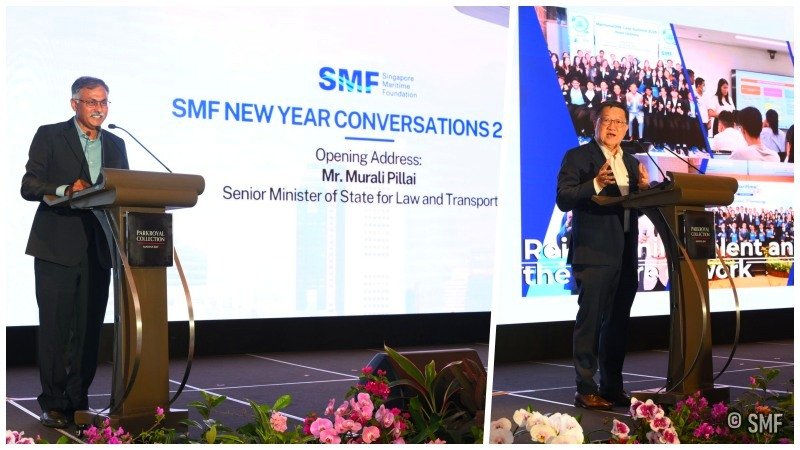
SINGAPORE | January 13, 2026 – The Singapore Maritime Foundation (SMF) gathered more than 250 industry leaders at the SMF New Year Conversations 2026, marking the first major maritime event of the year. The forum served as a critical platform for senior stakeholders to navigate a complex global outlook and reinforce sector cohesiveness amid rising geopolitical and energy-transition challenges.
With Mr. Murali Pillai, Senior Minister of State for Law and Transport, as Guest-of-Honour, the event served both as a reflection on a record-breaking 2025 and a forward-looking dialogue on how Maritime Singapore intends to navigate a year defined by volatility, decarbonisation, and operational risk.
Table of Contents
Singapore Enters 2026 from a Position of Strength
Opening the evening, Mr. Pillai highlighted that Singapore’s maritime sector is entering 2026 with unprecedented momentum, underpinned by strong fundamentals across bunkering, port operations, and ship registry growth. Singapore’s ability to remain a reliable anchor for global trade amid growing fragmentation.
Navigating a Complex Global Outlook
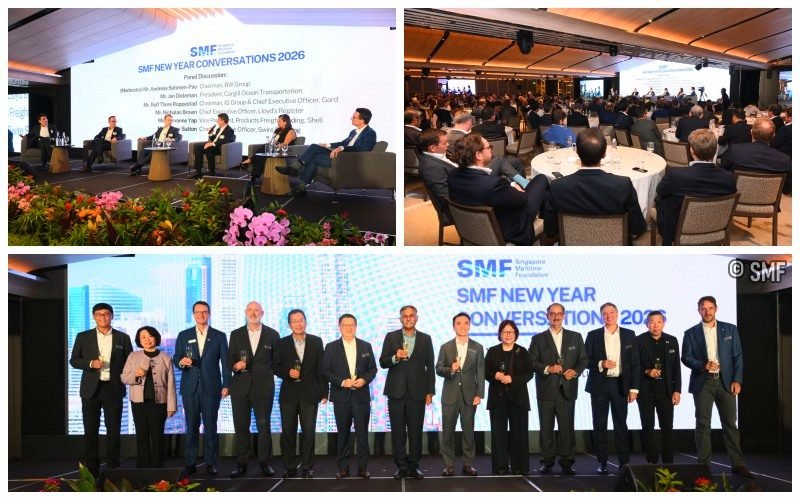
The centrepiece of the event was a high-level executive panel moderated by Mr. Andreas Sohmen-Pao, Chairman of BW Group, which tackled the theme of a “complex global outlook” and the need for ecosystem-wide cohesion.
The panel brought together senior leaders spanning the maritime value chain:
- Decarbonisation & Cargo: Jan Dieleman (Cargill) and Harvonne Yap (Shell) shared perspectives on freight demand stability, fuel transition pathways, and the scaling of cleaner marine fuels.
- Risk, Insurance & Regulation: Rolf Thore Roppestad (Gard) and Nicholas Brown (Lloyd’s Register) addressed rising operational risk, regulatory tightening, and the insurance implications of geopolitical instability.
- Operations & Connectivity: Jeremy Sutton (Swire Shipping) highlighted the practical challenges of maintaining liner connectivity and service reliability in an increasingly disrupted trading environment.
Discussions moved beyond market forecasts to examine how Singapore can function as a stabilising node in global supply chains as geopolitical tensions and trade realignments intensify.Car
Collaboration as a Competitive Advantage
For the bunkering and shipping community, a consistent message emerged: competitiveness in 2026 will be driven by collaboration, not isolation.
SMF Chairman Mr. Hor Weng Yew emphasised the foundation’s role as a trusted industry partner at a time when collective action is critical.
“Through platforms such as the annual New Year Conversations, the Singapore Maritime Foundation brings the industry together and provides an avenue for senior leaders across the ecosystem to connect, take stock of the industry’s developments, and share insights. As a trusted partner to both the public and private sectors, SMF will continue to work closely with our stakeholders to drive collective action on strategic priorities such as building the talent pipeline and enhancing Maritime Singapore’s competitiveness.”
Human capital featured prominently throughout the evening, with strong emphasis on the MPA–SMF Joint Office for Talent and Skills as the sector’s most critical long-term infrastructure.
The Multi-Fuel Reality Takes Shape
With the Maritime and Port Authority of Singapore (MPA) issuing new LNG and bio-methane bunker supply licences this week, panel discussions also turned to the operational realities of a multi-fuel bunkering environment.
Speakers stressed that while fuel availability is expanding, success will depend on:
- Crew training and certification
- Operational safety standards
- Credit risk management
- Coordinated regulatory frameworks
The conversation has clearly shifted from whether alternative fuels will scale, to how quickly and safely they can be integrated into daily operations.
What This Means for the Bunkering Community
For bunker suppliers and marine fuel stakeholders, the SMF New Year Conversations 2026 delivered several clear signals:
- Volume Leadership Is Being Reinforced, Not Challenged
Record bunker sales and rising alternative fuel volumes confirm Singapore’s dominance as a global refuelling hub. - Decarbonisation Is Now Operational, Not Theoretical
The presence of Shell and Cargill on the SMF stage reflects a market already executing on fuel transition strategies. - Registry Growth Equals Market Stability
The 27% growth in the Singapore Registry of Ships translates into a larger captive fleet, providing long-term demand stability for bunkering services. - Risk Management Will Define 2026 Performance
Credit exposure, geopolitical disruptions, and regulatory compliance will increasingly differentiate resilient bunker players from the rest.
Singapore Maritime Key Figures 2025 at a Glance
- Record Bunker Sales: Total bunker sales reached 56.77 million tonnes, marking a 3.4% year-on-year increase and reinforcing Singapore’s position as the world’s leading marine fuels hub.
- Surge in Alternative Fuels: Sales of alternative marine fuels climbed to 1.95 million tonnes, nearly doubling 2024 volumes and underscoring the rapid pace of the energy transition.
- Port Throughput Resilience: Container throughput rose to 44.66 million TEUs, up 8.6% year-on-year, despite disruptions across the Red Sea and Suez Canal.
- Registry Expansion: The Singapore Registry of Ships (SRS) surpassed 137 million gross tonnage, officially becoming the fourth-largest ship registry globally.
About the Singapore Maritime Foundation (SMF)
Established in 2004, the Singapore Maritime Foundation (SMF) fosters public-and-private sector collaboration, promotes Singapore as an International Maritime Centre (IMC), and develops a talent pipeline and skilled workforce to position Maritime Singapore for continued growth.
Source: Singapore Maritime Foundation