

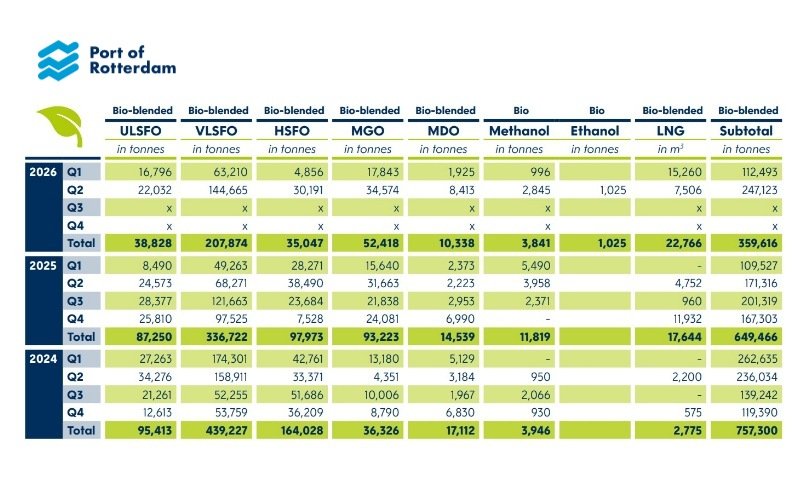
Rotterdam’s bunker volumes fell 25.1% in H1 2026 due to Dutch REDIII compliance costs and regional competition. Despite conventional fuel drops, alternative fuels surged 28%, led by robust demand for bio-LNG and novel bio-ethanol bunkering.
Rotterdam | July 29, 2026 – The Port of Rotterdam has reported a 25.1% decline in total bunker sales for the first half of 2026 compared to the same period last year, driven by a combination of strict new European environmental mandates, regional price discrepancies, and shifting trade routes.
Data released by the Port of Rotterdam Authority highlights that conventional fossil fuel oils absorbed the brunt of the contraction, plunging 28.3% overall. Specific conventional grades experienced severe downturns: Very Low Sulphur Fuel Oil (VLSFO) plummeted by 46%, Ultra Low Sulphur Fuel Oil (ULSFO) dropped 31%, and High Sulphur Fuel Oil (HSFO) fell 24%.
Regulatory Pressures and Regional Competition
Port officials pointed to the domestic implementation of the European Union’s RED III Directive in the Netherlands as a primary catalyst for the slump. Under the directive, local fuel suppliers are subject to stringent new sustainability obligations. This has sharply inflated the cost of conventional marine fuels in Rotterdam relative to rival bunkering ports both within and outside the Amsterdam-Rotterdam-Antwerp-Bruges (ARA) range.
Operating on razor-thin margins, commercial shipping lines have increasingly redirected vessel refuelling operations to competing regional ports to bypass heightened compliance costs. Ongoing energy market volatility, general price fluctuations, and shifting global trade routes have further exacerbated the redistribution of bunkering volumes.
A Silver Lining: Alternative Marine Fuels Surge
Despite the steep retreat in heavy fuel oils, Rotterdam’s transition toward green energy found notable momentum in the alternative fuel sectors. Sales of sustainable alternatives climbed 28% over the first six months of the year.
Demand for bio-LNG expanded significantly, cementing its role as a viable transitional fuel for dual-fuel fleets. Furthermore, the second quarter marked a historic operational milestone for the port with the inaugural bunkering of bio-ethanol. Port authorities noted that this milestone underscores the increasing readiness and commercial potential of novel alternative fuels to materially accelerate decarbonisation across the global maritime supply chain.
While Rotterdam maintains its status as one of the premier bunkering heavyweights globally, the H1 2026 results underscore how rapidly regulatory divergence can reshape European bunker market dynamics and compel ship operators to rethink their fueling strategies.
About the Port of Rotterdam Authority
The Port of Rotterdam is a pivotal economic engine for the Rotterdam-Rijnmond region, the Netherlands, and Europe. With its strategic location, world-class infrastructure, and efficient hinterland connections, the port serves as a critical hub for international trade and industry. The Port of Rotterdam Authority is committed to the sustainable development, management, and operation of the port, ensuring safe, efficient, and environmentally responsible handling of shipping. Its goal is to strengthen the port’s position as a future-proof logistics hub, focusing on quality, innovation, and the transition towards a climate-neutral port that aligns with its surrounding environment.
Source: The Port of Rotterdam