
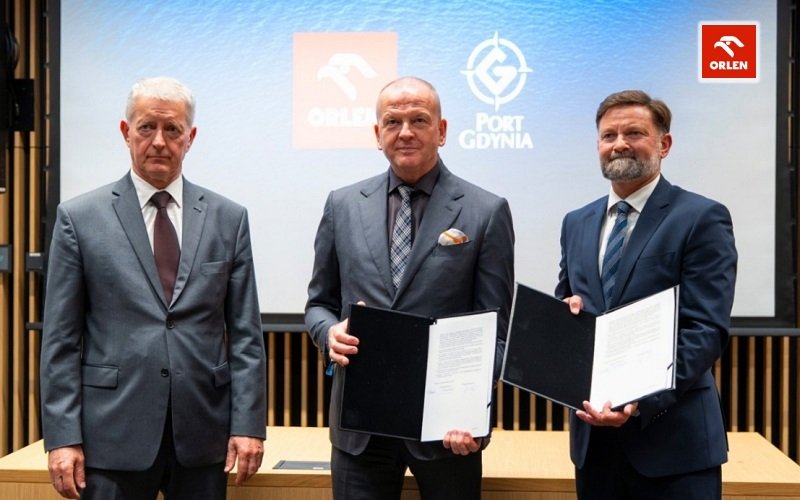
ORLEN and the Port of Gdynia Authority have signed an agreement to evaluate market demand and infrastructure requirements for LNG and bioLNG bunkering services along the Polish coast. The partnership will assess waterside operations, such as ship-to-ship transfers and simultaneous cargo handling, to support maritime decarbonization. This initiative aligns with ORLEN’s 2035 transition strategy and helps shipowners comply with tightening FuelEU Maritime regulations.
Gdynia, Poland | September 3, 2026 – Central European energy major ORLEN and the Port of Gdynia Authority have officially signed a strategic cooperation agreement to evaluate and expand the use of liquefied natural gas (LNG) and bioLNG as cleaner marine vessel fuels along the Polish coast.
The partnership aims to quantify long-term market demand for alternative bunkering services, analyze necessary port infrastructure, and establish the operational and regulatory frameworks required to position the Tricity region as a primary hub for green maritime logistics.
Strategic Scope and Operational Logistics
Under the terms of the accord, the collaboration will focus heavily on practical bunkering frameworks tailored to modern commercial shipping needs. Key evaluation metrics include:
- Waterside Bunkering Feasibility: Analyzing the viability of ship-to-ship transfer operations, where fuel is pumped directly from a bunker vessel to a vessel in port.
- Simultaneous Operations (SIMOPS): Assessing whether fueling can occur safely while a vessel is berthed alongside and actively engaged in parallel cargo-handling workflows.
- Fleet Targeting: Addressing the specific operational demands of major scheduled fleet users, specifically operators running container, ro-ro, and regular ferry services.
- Safety & Efficiency: Ensuring that all proposed models comply with strict safety mandates, maintain optimal berth availability, prevent traffic disruption, and preserve terminal continuity.
Driving Alignment with FuelEU Maritime Framework
The initiative is strategically timed to address a shifting regulatory landscape across Europe. The FuelEU Maritime framework, which entered into force in 2025, has introduced progressively stringent mandates tightening the greenhouse gas (GHG) intensity limits of energy utilized on board commercial ships.
To stay compliant, shipowners are increasingly evaluating multi-fuel pathways spanning LNG, bioLNG, green methanol, ammonia, and hydrogen. By spearheading local infrastructure development, ORLEN and the Port of Gdynia are laying the groundwork for an integrated regional alternative fuels ecosystem.
Executive Perspectives on the Energy Transition
Highlighting the long-term vision behind the partnership, Robert Soszyński, Vice President of the ORLEN Management Board, Operations, noted that the initiative forms a key pillar of ORLEN’s corporate fuel-portfolio transformation through 2035.
“Under the ORLEN Group’s strategy, gas, including LNG, will play a strategic role as a transitional fuel supporting energy security and the decarbonisation of transport,” Soszyński stated. “In parallel, we are developing capabilities in renewable fuels, including bioLNG, which could become one of the key pathways to lower emissions in heavy-duty road and maritime transport over the coming years. We want ORLEN to be more than a fuel supplier to ports; we aim to be a partner in their transition.”
Echoing this sentiment, Piotr Gorzeński, CEO of the Port of Gdynia Authority, emphasized the necessity of operational agility in an uncertain technological climate.
“Energy transition in the shipping industry is already under way. Shipowners are looking for solutions that could reduce emissions, while ports need to be ready to accommodate vessels using a range of fuels and technologies,” Gorzeński said. “We want the Port of Gdynia to be prepared for what the future may bring, because no one can say with certainty which solutions will matter most 10 or 20 years from now.”
The collaborative framework will also involve comprehensive knowledge sharing, benchmarking against other leading European ports, and evaluating best practices to ensure Poland’s maritime infrastructure keeps pace with global decarbonization milestones.
Port of Gdynia Authority SA
Port of Gdynia Authority acts as the strategic managing body for one of the Baltic Sea’s premier universal ports. Established on November 30, 1999, by the Municipality of Gdynia and the State Treasury under the Polish Act on Ports and Harbours, PGA SA oversees the port’s property, infrastructure maintenance, safety standards, and environmental compliance.
To optimize efficiency, PGA SA separates port management from commercial operations by privatizing subsidiary shares while retaining underlying land and property assets. This structure boosts capital strength and cements the port’s critical role within the European North-South transport corridor and the broader Baltic maritime ecosystem.
About ORLEN SA
ORLEN SA is committed to powering the future for more than 100 million Europeans while redefining the landscape of regional energy security and sustainability. As a frontrunner in Central Europe’s energy transition, the company is actively deploying eco-friendly technologies, scaling up low- and zero-emission generation assets, and modernizing its core industrial infrastructure. By harmonizing traditional business value with a rigorous decarbonization roadmap, ORLEN is successfully delivering advanced, customer-centric solutions that drive long-term environmental and economic resilience.
Source: ORLEN