
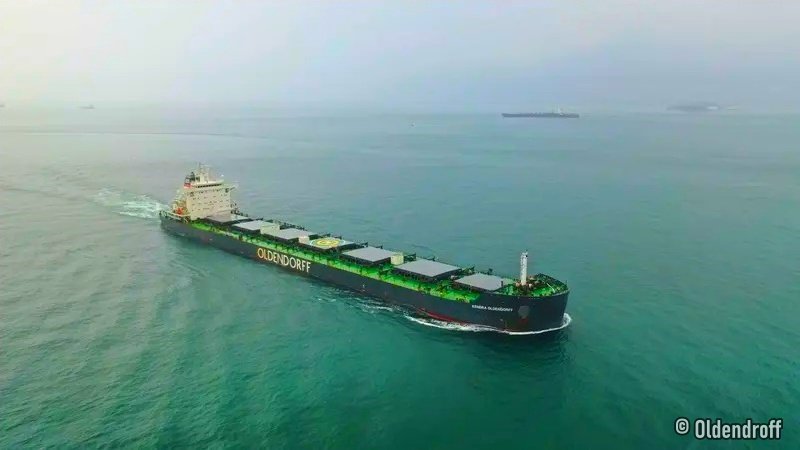
Hamburg | January 23, 2026 – Dry bulk giant Oldendorff Carriers has entered into a strategic partnership with Swedish technology firm eMarine to deploy Variable Frequency Drive (VFD) technology across its fleet. The move marks a significant step in Oldendorff’s data-driven decarbonisation strategy, with 13 vessels already outfitted and the remainder of the owned fleet set to follow.
The implementation focuses on one of the most consistent energy consumers onboard: cooling pumps. By replacing traditional constant-speed systems with VFDs, Oldendorff is now able to align pump speeds with real-time operational demand and ambient conditions, eliminating the “full power” waste common in older vessel designs.
Table of Contents
Data-Backed Results: 5,000 Tonnes of CO2 Saved
The initial rollout has already yielded substantial environmental and financial dividends. Oldendorff reports an estimated reduction of over 5,000 tonnes of CO2 to date. To put this in perspective for stakeholders, this is equivalent to removing approximately 1,050 gasoline-powered passenger vehicles from the road for an entire year.
“The installation of Variable Frequency Drives is a strong example of how we leverage technology to drive efficiency gains across our fleet,” said Niklas Richter, Head of Fleet Projects and Drydock Coordination at Oldendorff. “By using smart systems that adapt energy consumption to real operating conditions and allow performance to be monitored from shore, we can reduce emissions while continuously improving operational efficiency.”
Selection Criteria: Performance and Monitoring
Following a rigorous evaluation of multiple technology providers, Oldendorff selected eMarine based on a “lifecycle cost” approach. Key factors in the decision included system flexibility, technical support, and the ability to integrate with the eMarine.cloud platform for continuous shore-based performance monitoring.
“We are proud to support Oldendorff in their ongoing efforts to improve fleet-wide energy efficiency. This project demonstrates how proven onboard technologies, combined with structured energy optimisation and continuous follow-up through our eMarine.cloud platform, can deliver measurable and sustainable results at scale. By providing transparency, data-driven insight and long-term support, we support Oldendorff in continuously improving operational efficiency and reducing emissions across the fleet,,” noted Ola Persson, CEO of eMarine.
Part of a Larger Decarbonisation Ecosystem
The VFD rollout is not a standalone initiative but part of a broader technical overhaul of Oldendorff’s 100-vessel owned fleet. Other technologies currently in play include:
- Becker Mewis Ducts and Rudder Bulbs: For propulsion efficiency.
- Auxiliary Engine Economisers: For heat recovery.
- Optimised Hull Designs: Utilizing advanced silicone-based coatings.
Technical Insight: The “Cube Law” of Fuel Savings
The reason the eMarine Control™ system offers such a fast ROI (9–18 months) is rooted in the Affinity Laws of fluid mechanics. For centrifugal pumps, the primary consumers in a ship’s cooling system, power consumption is proportional to the cube of the motor speed.
- At Sea: A vessel’s cooling system is designed for “worst-case” scenarios (e.g., 32°C seawater in the tropics). When sailing in 15°C water, the system typically wastes energy by “throttling” valves. A VFD slows the motor instead.
- The 20% Rule: Reducing pump speed by just 20% cuts electrical power consumption by nearly 50%.
- In Port: During loading or discharge, cooling demand drops significantly as the main engine is idle. Without a VFD, these pumps continue to run at 100%, wasting fuel 24/7.
Fuel Impact Table
| Vessel Condition | Cooling Demand | Standard Pump Load | eMarine VFD Load | Fuel Saving Potential |
| Tropical Transit | High | 100% | 90-100% | 0 – 27% |
| Northern Transit | Moderate | 100% | 60-70% | 40 – 65% |
| At Anchorage/Port | Low | 100% | 40-50% | Up to 80% |
Why it matters:
As carbon pricing (EU ETS) and stricter fuel regulations take hold, the ability to shave 10-15% off auxiliary fuel consumption becomes a critical competitive advantage in the spot and time-charter markets.
- Fuel Efficiency: Directly reduces the load on diesel generators, leading to measurable drops in fuel consumption.
- Rapid Payback: Most installations achieve a Return on Investment (ROI) within 9 to 18 months.
- Data-Driven Decisions: Through eMarine Cloud, operators can access live performance data and remote diagnostics from the Remote Operation Center (ROC).
- Sustainability: Reduced fuel burn translates directly to lower CO2 emissions, helping fleets meet CII (Carbon Intensity Indicator) targets.
Oldendorff Carriers in Brief
Oldendorff Carriers is one of the world’s leading dry bulk shipping companies, with a fleet of 100 modern “eco-type” owned vessels. Headquartered in Germany, the company provides global maritime transport for essential raw materials such as iron ore, coal, and grain. Oldendorff is a pioneer in maritime innovation, partnering with institutions like MIT and the University of Strathclyde to develop disruptive ship designs. As a founding member of the North Pacific Green Corridor Consortium (NPGCC), the company is at the forefront of the industry’s transition to alternative fuels and net-zero operations.
Source: Oldendroff Carriers