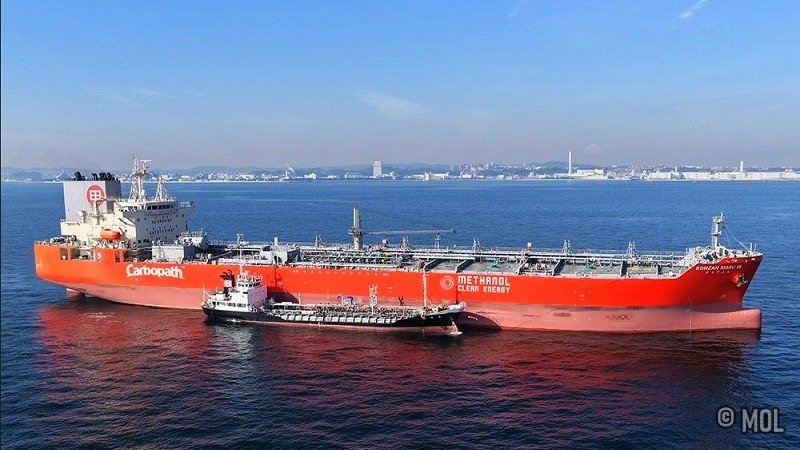
Tokyo | February 09, 2026 – In a landmark moment for Japan’s maritime decarbonization journey, Mitsui O.S.K. Lines, Ltd. (MOL) has completed Japan’s first ship-to-ship (STS) methanol bunkering operation at anchorage, marking a decisive breakthrough in the commercialization of alternative marine fuels and the operational readiness of methanol-fueled vessels.
The historic operation was carried out in the Yokohama District of Keihin Port, where methanol vessel fuel was safely transferred offshore between two active vessels, an achievement long viewed as a critical benchmark for scaling methanol bunkering beyond controlled berth environments.
Table of Contents
The Anatomy of a Milestone: The Five-Party Alliance
The historic operation waThe operation brought together a rare and tightly coordinated five-party public–private partnership, combining ship operations, fuel supply, chemical production, port governance, and regulatory alignment:
- Mitsui O.S.K. Lines, Ltd. (MOL) – Operator of the receiving vessel and a global leader in methanol carrier operations
- City of Yokohama – Host authority advancing Yokohama Port as a flagship Carbon Neutral Port
- Kokuka Sangyo Co., Ltd. – Operator of the bunkering vessel with decades of specialized chemical transport expertise
- Idemitsu Kosan Co., Ltd. – Strategic partner supporting the domestic methanol supply chain
- Mitsubishi Gas Chemical Company, Inc. (MGC) – Supplier of domestically produced biomethanol from its Niigata Plant
Collectively referred to as the Five Parties, the consortium executed the operation on Friday, February 6, 2026, establishing a new operational precedent for how methanol bunkering can be safely, efficiently, and routinely integrated into Japan’s port ecosystem.
“This project represents a significant milestone in promoting methanol bunkering within Japan,” the parties said in a joint statement. “Anchorage bunkering is already widely used for conventional fuels. Establishing this capability for methanol is essential for the future development of green shipping corridors.”
First-of-Its-Kind Methanol STS Bunkering at Anchorage
While methanol bunkering has previously been conducted at berths, this marks the first successful transfer at offshore anchorage (NR Anchorage) in Japan.
For the bunkering industry, anchorage-based STS operations represent a critical operational benchmark. By demonstrating that methanol can be safely handled away from the quay, the project confirms that methanol-fueled vessels can refuel without competing for limited berth space, significantly improving vessel turnaround times and enhancing port competitiveness.
This capability is increasingly viewed as essential if Japanese ports are to match global bunkering hubs such as Singapore and Rotterdam as methanol demand accelerates.
Operation Summary
Date: Friday, February 6, 2026
Location: Keihin Port, Yokohama District – NR Anchorage
Fuel transfer:
- Bunkering vessel: Eika Maru (1,259 DWT), operated by Kokuka Sangyo
- Receiving vessel: Kohzan Maru VII (47,960 DWT), a dual-fuel methanol carrier operated by MOL
Both vessels are chartered by Mitsubishi Gas Chemical.
Why Methanol Matters
Methanol is rapidly gaining traction as a preferred alternative to conventional marine fuels due to its favorable handling characteristics. Unlike LNG, methanol remains liquid at ambient temperatures, eliminating the need for cryogenic storage at –162°C and allowing greater compatibility with existing fuel infrastructure.
MGC’s proprietary Carbopath™ platform exemplifies circular-economy fuel production:
- Feedstock: Captured CO₂, waste plastics, and biomass
- Process: Conversion into methanol using proprietary catalysts
- Environmental impact: Methanol can reduce SOx emissions by up to 99%, NOx by as much as 60%, and, when produced from non-fossil sources, enable near carbon-neutral marine transport across its lifecycle
Regulatory Rigor Paved the Way
This operation was the culmination of two years of intense work by the Ministry of Land, Infrastructure, The operation was the culmination of nearly two years of regulatory and technical groundwork led by Japan’s Ministry of Land, Infrastructure, Transport and Tourism (MLIT).
Through the “Study Group on the Formation of Methanol Bunkering Hubs” (2024–2025), MLIT established Japan’s first national framework governing methanol bunkering, including:
- Standardized bunkering procedures
- Risk assessment and simulation methodologies
- Safety management and emergency response protocols
- Coordination mechanisms between port authorities, operators, and regulators
Insights from a methanol bunkering simulation conducted at Yokohama Port in September 2024, along with expertise from chemical logistics and vessel operators, directly informed the safety measures applied during the live operation. Close coordination with the Japan Coast Guard further ensured regulatory compliance.
The successful bunkering of Kohzan Maru VII now serves as a verified operational reference that will support the expansion of methanol bunkering to other vessel types and ports across Japan.
A Turning Point for Methanol Bunkering in Japan
Anchorage bunkering is prized globally for its operational flexibility and efficiency, minimizing berth congAnchorage bunkering is globally valued for its flexibility and efficiency. By proving that the same operational model can be safely applied to methanol, this project significantly lowers the barriers to adoption.
For Japan, the operation represents:
- The first STS methanol bunkering at anchorage
- The first such operation for methanol-fueled vessels already in commercial service
- A major step toward establishing nationwide methanol bunkering hubs
Post-operation verification is now underway, with stakeholders organizing lessons learned to support broader deployment.
Aligning with Yokohama’s Carbon Neutral Port Vision
For the City of Yokohama, the operation directly supports its ambition to achieve carbon neutrality at Yokohama Port by 2050. The city is actively promoting next-generation marine fuels, decarbonization of coastal industries, and clean-energy industrial clustering through collaboration with national authorities and private industry.
Industry implications
The message to the global shipping industry is clear: “Methanol bunkering at anchorage is no longer theoretical, it is operationally proven.”
As demand for methanol-fueled vessels continues to grow, Japan has positioned itself to support that fleet with safe, flexible, and scalable bunkering solutions. The Yokohama operation now stands as a blueprint, demonstrating how regulation, technology, fuel supply, and operational expertise can converge to turn maritime decarbonization from ambition into reality.
The Strategic Coalition: Architecture of the Alliance
1. Mitsubishi Gas Chemical (MGC): The Molecular Architects
MGC is the cornerstone of the fuel supply chain, operating as Japan’s only integrated methanol producer. Their mission, “Creating value to share with society,” is physically manifested in the Carbopath™ platform.
- The Innovation: MGC utilizes proprietary catalysts to synthesize methanol from “waste” carbon (captured CO2, biomass, and plastics).
- The Role: By providing the ISCC PLUS-certified biomethanol for this operation, MGC has transitioned from a chemical manufacturer to a primary energy provider for the maritime sector.
2. Mitsui O.S.K. Lines (MOL): The Operational Vanguard
As the operator of the Kohzan Maru VII, MOL is the primary driver of demand in this ecosystem. Since pioneering the world’s first methanol dual-fuel vessel in 2016, MOL has evolved into a global authority on methanol logistics.
- The Vision: Under “Environmental Vision 2.2,” MOL is aggressively scaling its fleet to 90 LNG/methanol-powered vessels by 2030, leveraging decades of safety data to normalize alternative fuel handling.
3. Kokuka Sangyo: The Precision Logistics Experts
Established in 1947, Kokuka Sangyo is the “silent partner” with the technical muscle. They specialize in the high-stakes world of chemical maritime transport, specifically molten sulfur and methanol.
- The Role: Operating the bunkering vessel Eika Maru, they provided the specialized crew and equipment necessary for the delicate STS transfer at anchorage. Their expertise in “specialty tankers” ensures that high-purity fuels like biomethanol are handled without contamination.
4. Idemitsu Kosan: The Energy Transition Powerhouse
Idemitsu is a titan of the Japanese petroleum sector currently pivoting toward “Energy One-Step Ahead.” They are building the infrastructure for a post-oil world.
- The Focus: Idemitsu’s role is critical in the societal implementation of e-methanol and synthetic fuels. By leveraging their massive domestic distribution network and international MOUs (such as with HIF Global), they ensure that green methanol moves from the laboratory to the bunker station.
5. City of Yokohama: The “Carbon Neutral Port” Host
Yokohama isn’t just a location; it is an active participant. The city’s waterfront accounts for nearly 40% of its total emissions, making the “Carbon Neutral Port 2050” initiative a matter of existential and economic urgency.
- The Strategy: By facilitating these trials, the City of Yokohama is creating an industrial “cluster” where decarbonized shipping and coastal industries feed into one another, positioning the port as the greenest gateway to Asia.
Source: Mitsui O.S.K. Lines, Ltd. (MOL)