
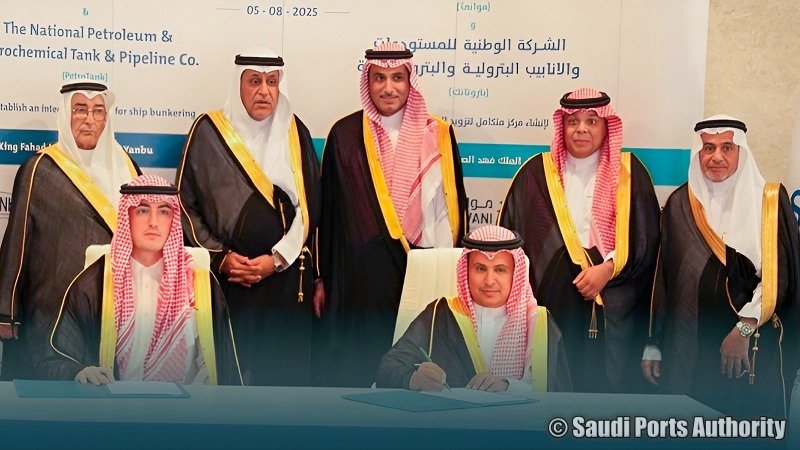
Yanbu, Saudi Arabia — August 06, 2025 – In a major step forward for Saudi Arabia’s maritime logistics and bunkering capabilities, the Saudi Ports Authority (Mawani), a leading Saudi ports organization, has signed a landmark land lease agreement with the National Petroleum & Petrochemical Tanks & Pipeline Co. (Petrotank). This strategic partnership will establish a state-of-the-art integrated marine bunkering hub at King Fahad Industrial Port in Yanbu, representing a total investment of SAR 500 million and covering 110,700 square meters under a 20-year lease.
The signing ceremony was officiated by Captain Maher bin Abdulrazzaq Al-Hamdi, General Executive Manager of King Fahad Industrial Port, and Mr. Fares Zuhair Al-Bakri, Chairman of Petrotank. The event was held in the presence of H.E. Eng. Khalid bin Mohammed Al-Salem, President of the Royal Commission for Jubail and Yanbu, along with several senior officials and dignitaries.
Table of Contents
Boosting Port Competitiveness and Bunkering Services
This significant initiative aligns with Mawani’s broader strategy to enhance the efficiency, attractiveness, and competitiveness of Saudi ports both regionally and globally. The development of this dedicated bunkering hub is a critical infrastructure enhancement, delivering vital fuel and oil storage capabilities to support increased maritime activity and advance Saudi Arabia’s logistics ambitions under the National Transport and Logistics Strategy (NTLS).
Speaking on the occasion, H.E. Eng. Suliman bin Khalid Almazroua, President of the Saudi Ports Authority, emphasized that the collaboration reflects Mawani’s mission to transform Saudi ports into world-class investment destinations. He noted:
“The establishment of an integrated marine bunkering hub at King Fahad Industrial Port in Yanbu is a cornerstone in our roadmap to elevate the services offered to shipping lines. This development will not only improve operational efficiency and vessel turnaround but also attract more global maritime traffic—reinforcing the Kingdom’s position as a pivotal logistics gateway connecting three continents. This aligns directly with the goals of Vision 2030 to empower and grow the logistics and maritime sectors.”
A Strategic Expansion of Existing Capabilities
This is not the first collaboration between Petrotank and Mawani aimed at strengthening the Kingdom’s marine fuel infrastructure. Petrotank already operates a fully functional fueling station at King Fahad Industrial Port, featuring eight storage tanks with a total storage capacity of 114,000 cubic meters. This existing facility plays a vital role in supporting port operations and ensuring reliable vessel fueling services.
The newly announced project marks a substantial scale-up of current operations. The integrated marine bunkering hub will incorporate advanced fuel storage tanks, marine loading arms, interconnecting pipeline systems, and state-of-the-art control infrastructure. All facilities will be built in compliance with international environmental and operational standards, specifically adhering to Marine Terminal Safety Management System (MTMSA) guidelines, representing the highest level of industry best practices.
With this expansion, the new bunkering facility will cater to a broader range of vessels—including bulk carriers, tankers, and container ships—transiting the Red Sea and calling at Yanbu. The strategic geographic position of King Fahad Industrial Port makes it an ideal regional refueling center, especially given the rising vessel traffic along the Suez Canal and the Red Sea corridor.
Saudi Arabia’s Bunkering and Marine Fuels Landscape
Saudi Arabia is strategically positioned to become a major global player in the bunkering sector due to its extensive coastline along both the Red Sea and Arabian Gulf, sitting adjacent to key international shipping lanes. The Kingdom’s efforts are focused on increasing the availability and volume of traditional marine fuels such as VLSFO, HSFO and Marine Gas Oil (MGO), while also actively developing infrastructure to support cleaner fuel alternatives like LNG bunkering. These initiatives are in alignment with international environmental regulations, including the IMO 2020 sulfur cap.
In parallel, significant investments in advanced fuel management technologies and the ongoing expansion of marine fueling facilities are key steps toward enhancing the Kingdom’s competitiveness as a maritime hub and positioning it as a reliable supplier of marine fuels on the global stage.
King Fahad Industrial Port: A Key Industrial Gateway
Located on the Red Sea coast, King Fahad Industrial Port in Yanbu is one of Saudi Arabia’s principal industrial maritime gateways. The port spans 6.8 square kilometers, includes 34 berths and 10 specialized terminals, and boasts an annual cargo throughput capacity of 210 million tons. It is fully equipped to handle a wide variety of cargo, including crude oil, refined petroleum products, petrochemicals, and dry bulk materials.
The port’s robust infrastructure, combined with the upcoming bunkering hub, positions it as a critical enabler of Saudi Arabia’s growing industrial base and export capacity. This project strengthens the port’s role as a strategic node in the Kingdom’s logistics chain and a vital energy and trade corridor on the Red Sea.
Aligning with Saudi Vision 2030
The establishment of this integrated marine bunkering hub is a tangible demonstration of Saudi Arabia’s Vision 2030 in action. This national economic transformation plan aims to diversify the Kingdom’s economy, reduce dependence on oil exports, and position Saudi Arabia as a global hub for logistics, industry, and innovation.
Key logistics-related objectives under Vision 2030 include:
- Increasing the logistics sector’s contribution to GDP,
- Enhancing Logistics Performance Index (LPI) scores,
- Attracting foreign direct investment (FDI) in infrastructure.
By enhancing port infrastructure and expanding high-value services such as bunkering, Mawani is actively advancing these goals. The project directly contributes to strengthening Saudi Arabia’s role as a vital link in global supply chains and as a premier destination for maritime trade and investment.
Conclusion
The launch of the SAR 500 million integrated marine bunkering hub at King Fahad Industrial Port in Yanbu marks a major milestone in Saudi Arabia’s maritime and energy logistics sectors. It underscores the Kingdom’s commitment to becoming a leading global player in the bunkering and port services industry. Backed by Petrotank’s operational capabilities and Mawani’s regulatory leadership, this project will transform Yanbu into a world-class bunkering and logistics hub on the Red Sea—delivering cutting-edge fueling services to the global maritime community and contributing significantly to the Kingdom’s long-term economic transformation.
About National Petroleum & Petrochemical Tanks & Pipeline Co. (Petrotank)
National Petroleum & Petrochemical Tanks & Pipeline Co. (Petrotank) is a leading developer and operator of petroleum products storage and bunkering infrastructure in Saudi Arabia. The company’s terminal facility at King Fahad Industrial Port includes storage tanks, pumping stations, and marine fueling systems, designed to manage a wide variety of petroleum products. The facility is connected to the existing Port Authority Berths, enabling seamless product receipt and discharge via ocean-going vessels. It adheres to the highest international standards, including MTMSA, and follows stringent quality and operational safety protocols.
About Saudi Ports Authority (Mawani)
Saudi Ports Authority (Mawani), established in 1976, is the regulatory body responsible for overseeing the Kingdom’s port operations. Mawani is committed to transforming Saudi ports into globally competitive logistics platforms through strategic investments, modernization, and public-private partnerships. The authority’s mission supports the goals of Vision 2030 and the National Transport and Logistics Strategy, with a focus on sustainability, innovation, and enabling a safe, efficient, and prosperous maritime sector.
Source Saudi Ports Authority (Mawani)