
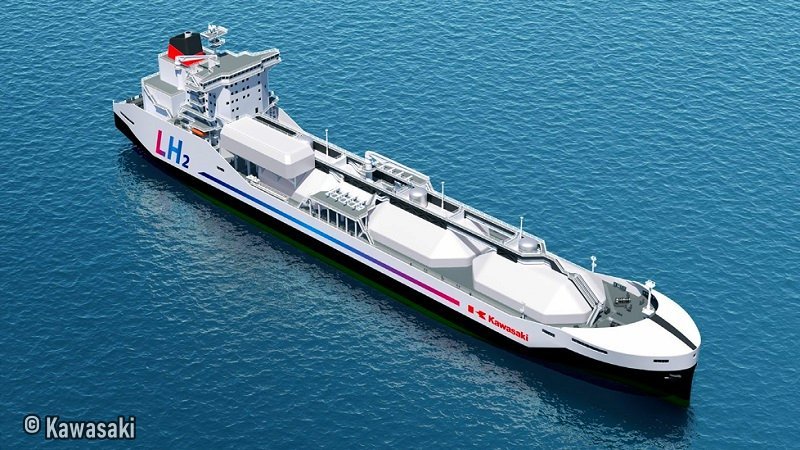
Tokyo, Japan | January 6, 2016 – In a move that signals the transition of the hydrogen economy from pilot projects to industrial-scale reality, Kawasaki Heavy Industries (KHI) and Japan Suiso Energy (JSE) have signed a landmark contract to construct the world’s largest liquefied hydrogen LH2 carrier.
The vessel, boasting a capacity of 40,000 cubic metres, will be built at Kawasaki’s Sakaide Works in Kagawa Prefecture. This project serves as the cornerstone of Japan’s Green Innovation Fund, a government-backed initiative managed by NEDO (New Energy and Industrial Technology Development Organization) to establish a commercial-scale hydrogen supply chain by 2030.
Table of Contents
A 30-Fold Leap in Scale
The new vessel represents a massive technological scale-up from the Suiso Frontier, the world’s first LH2 carrier delivered by Kawasaki in 2021, which held a capacity of just 1,250 m3. This thirty-fold increase in volume is designed to meet the projected global surge in hydrogen demand expected by the early 2030s.
“The construction of this vessel provides the foundation for the future hydrogen supply chain,” KHI stated. “It is designed to demonstrate performance, safety, and economics required for global commercialization.“
Technical Breakthroughs: The “Zero-Boil-Off” Goal
Transporting hydrogen at its boiling point of -253°C (just 20 degrees above absolute zero) presents extreme technical challenges. Kawasaki is integrating several “first-of-kind” features:
- High-Performance Insulation: A specialized vacuum-insulation system designed to minimize Boil-Off Gas (BOG) during long-haul voyages.
- Dual-Fuel Hydrogen Propulsion: For the first time at this scale, the vessel will feature a hydrogen/oil dual-fuel generator engine. This allows the ship to use the naturally occurring boil-off gas from its cargo as fuel, drastically reducing CO2 emissions during transport.
- Vacuum-Jacketed Cargo Systems: Double-wall, vacuum-jacketed piping will be used to ensure the safe and efficient transfer of cryogenic liquid between the ship and onshore terminals.
Building the Ogishima Hub
JSE will operate the vessel as part of a demonstration project connecting international supply sources to the Kawasaki LH2 Terminal currently under construction at Ogishima. This terminal will feature a 50,000 m3 storage tank, creating a localized hub for ship-to-shore loading and subsequent distribution for mobility and industrial power generation.
| Specifications | Details |
| Overall Length | Approx. 250.00 m |
| Molded Breadth | 35.00 m |
| Cargo Capacity | 40,000 $m^3$ |
| Propulsion | Diesel/Hydrogen-fueled electric |
| Service Speed | 18.0 knots |
| Classification | ClassNK |
Why This Matters for Bunkering
For the maritime fuel industry, this contract is a major indicator that liquefied hydrogen is moving into the “Mainstream Tonnage” category. By developing dual-fuel engines that can handle hydrogen BOG, Kawasaki is providing a blueprint for the future of zero-emission deep-sea shipping.
About Kawasaki Heavy Industries
With a heritage spanning over a century, Kawasaki Heavy Industries operates as a global “technology corporate group” whose engineering expertise reaches from the ocean depths to outer space. The company’s diverse industrial portfolio encompasses the production of Shinkansen high-speed trains, aerospace satellites, and specialized naval submarines, alongside its world-renowned “Kawasaki” brand motorcycles.
In the maritime sector, Kawasaki has established itself as a pioneer in cryogenic transport, transitioning from large-scale gas carriers to the development of the world’s first liquefied hydrogen supply chains. By leveraging high-level engineering across energy solutions, industrial robotics, and environmental plants, the group continues to solve complex global challenges through unmatched technical innovation.
Source: Kawasaki Heavy Industries