
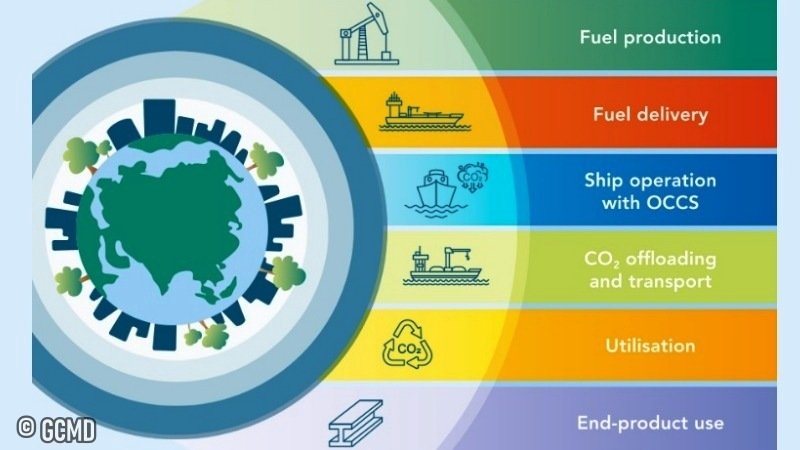
Singapore | January 06, 2026 – The Global Centre for Maritime Decarbonisation (GCMD) has released a landmark Life Cycle Assessment (LCA) that could redefine the commercial viability of Onboard Carbon Capture and Storage (OCCS).
The study, verified by DNV, analyzes the results of Project CAPTURED, which in June 2025 achieved the world’s first ship-to-ship (STS) offloading of captured liquefied CO₂ (LCO₂). The findings suggest that when the value chain is optimized, OCCS isn’t just a marginal gain, it’s a massive decarbonization lever.
Table of Contents
The Pilot Results: 7.9% Savings Under “First-of-a-Kind” Constraints
The pilot took place aboard the Evergreen vessel Ever Top, using a capture system that operated at a 10.7% capture rate.
- Current Achievement: 7.9% net GHG savings across the entire value chain.
- Efficiency Ratio: For every 1 tonne of CO₂ captured and offloaded, 0.84 tonnes of net savings were realized.
While 7.9% may seem modest, the GCMD emphasizes that these results were achieved under significant “first-time” hurdles, including the lack of a waste heat recovery system on the vessel and 2,200km of overland truck transport.
The Potential: 17.8% to 71% Savings
The LCA reveals that by simply addressing operational inefficiencies, such as using waste heat for the capture process and optimizing logistics, the emissions savings for the same pilot would have jumped to 17.8%.
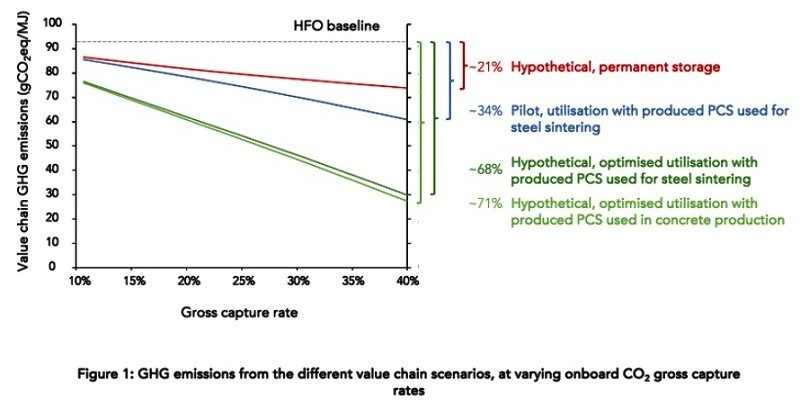
More strikingly, the study looked at a future scenario with a 40% capture rate (the industry target for mid-term OCCS):
- Utilisation vs. Storage: Mineralizing the CO₂ into precipitated calcium carbonate (PCC) for use in building materials yielded 34% GHG savings.
- Storage Only: Sequestration in an offshore reservoir yielded only 21% savings.
- The “Ideal” Scenario: In a fully optimized value chain using captured carbon for steel sintering or concrete, total GHG savings could soar to 68–71%.
A Warning to Regulators: The “Avoided Emissions” Gap
Perhaps the most controversial finding in the report is that current regulatory frameworks, including the IMO’s Carbon Intensity Indicator (CII) and LCA Guidelines, risk killing the OCCS market before it starts.
Currently, these frameworks do not account for “avoided emissions”, the carbon saved when captured CO₂ replaces a high-emission industrial product (like traditional cement or mined calcium carbonate).
“Project CAPTURED shows that onboard carbon capture, when thoughtfully integrated with utilisation pathways, can deliver real emissions reductions today while we continue to scale up low- and zero-carbon fuels. It also highlights how we measure and account for those reductions matter. If our frameworks continue to ignore avoided emissions and displaced carbon, we risk disincentivising investments in solutions that can meaningfully bend the emissions curve.” said Professor Lynn Loo, CEO of GCMD.
Strategic Implications for Bunkering Hubs
For bunker suppliers and port authorities, this news highlights a shift in what a “bunkering hub” will look like in 2030.
- LCO₂ Infrastructure: Ports will need to develop LCO₂ receiving facilities and ship-to-ship transfer protocols alongside traditional fuel bunkering.
- Circular Economy: Coastal industrial clusters (cement, steel, and chemicals) will become essential partners for the shipping industry to “dispose” of captured carbon profitably.
- Mid-Term Viability: For shipowners, OCCS offers a way to extend the life of HFO-powered vessels while complying with the tightening noose of the EU ETS and IMO targets.
Comparison: Utilization vs. Permanent Storage (at 40% Capture)
| Metric | CO₂ Mineralization (Utilisation) | Offshore Sequestration (Storage) |
| Net GHG Savings | 34% | 21% |
| Optimized Potential | Up to 71% | Lower (due to transport/energy) |
| Regulatory Status | Not yet fully recognized by IMO | Recognized (with caveats) |
| End Product | Concrete, Slag, Paper, Plastics | Underground Reservoir |
About the Global Centre for Maritime Decarbonisation – GCMD
The Global Centre for Maritime Decarbonisation (GCMD) was established as a non-profit organisation on 1 August 2021 with a mission to support the decarbonisation of the maritime industry by shaping standards, deploying solutions, financing projects, and fostering collaboration across sectors.
- Founders: BHP, BW Group, Eastern Pacific Shipping, Foundation Det Norske Veritas, Ocean Network Express and Seatrium.
- Funding: GCMD receives funding from the Maritime and Port Authority of Singapore (MPA) for qualifying research and development programmes and projects.
- Strategic Partners: bp, Hanwha Ocean, Hapag-Lloyd, NYK Line and PSA International have joined as Strategic partners.
- Initiatives: GCMD has launched key initiatives to close technical and operational gaps in: deploying ammonia as a marine fuel, developing an assurance framework for drop-in green fuels, unlocking the carbon value chain, and closing the data-financing gap for energy efficiency technologies.
- Location: Strategically located in Singapore, the world’s largest bunkering hub and busiest transshipment port.