
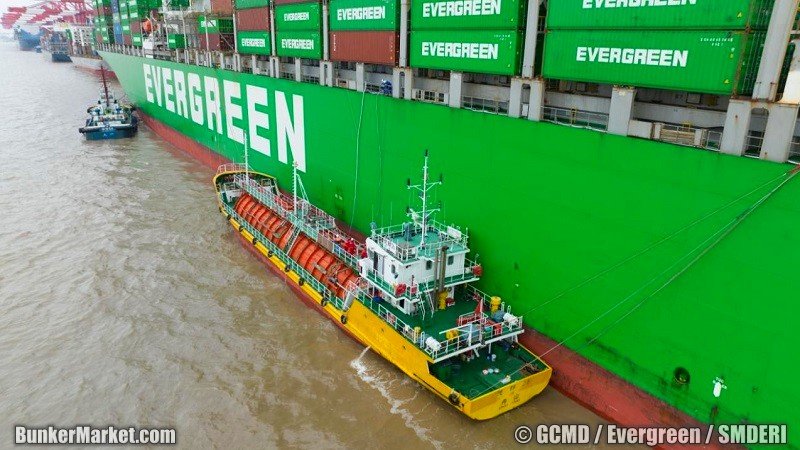
GCMD charts the world’s first full value chain for onboard captured CO₂ — encompassing offloading, handling, transport, and utilisation.
Singapore/China – 30 June 2025 – In a landmark achievement for maritime sustainability and carbon innovation, the Global Centre for Maritime Decarbonisation (GCMD), in collaboration with a broad coalition of ecosystem partners, has successfully demonstrated the world’s first end-to-end value chain for onboard captured carbon dioxide (CO₂). This milestone pilot marks a significant leap toward viable carbon management in shipping, showcasing real-world potential for the capture, offloading, transportation, and industrial reuse of CO₂ collected directly from vessels at sea.
Table of Contents
End-to-End CO₂ Handling – A World-First Pilot Across Borders
Conducted under actual operational constraints, the pilot unfolded in two distinct but interconnected phases.
In Phase One, China-based Shanghai Qiyao Environmental Technology Co., Ltd. (SMDERI-QET) facilitated the first-ever ship-to-ship (STS) transfer of onboard captured CO₂. A total of 25.44 metric tonnes (MT) of liquefied CO₂ was transferred from the container vessel MV Ever Top, owned by Evergreen Marine Corp, to the receiving vessel Dejin 26. This operation occurred off the coast of Zhoushan, Zhejiang Province.
Following the maritime transfer, the CO₂ was offloaded at a local jetty onto a tank truck—marking a seamless transition from marine logistics to land-based handling.
Phase Two—led by GCMD—saw the CO₂ transported over 2,000 kilometers inland to a joint venture plant operated by GreenOre and Baotou Steel in Inner Mongolia. There, the liquefied CO₂ (LCO₂) was repurposed as a feedstock in the production of low-carbon calcium carbonate, a crucial input in sustainable construction materials. This not only completed the carbon value chain but also underscored the potential for CO₂ circularity in industrial ecosystems.
Unlocking the Full Carbon Value Chain in Maritime Decarbonisation
While onboard carbon capture is a critical technological lever in reducing shipping emissions, its true value lies in the complete lifecycle management of captured CO₂. This demonstration addresses that imperative—moving beyond capture to include:
- Safe offloading from vessels
- Regulatory-compliant transportation
- Industrial reuse in low-carbon product manufacturing
According to GCMD’s own COLOSSUS study, utilisation of CO₂ in concrete and construction materials offers among the highest GHG savings across all evaluated pathways, due to the avoided emissions from traditional cement production.
This pilot transforms captured CO₂ from waste to climate-positive asset—highlighting its potential to play a critical role in decarbonising not just the maritime sector, but the built environment as well.
Overcoming Real-World Barriers: Regulatory and Logistical Milestones
The project wasn’t without its challenges. One major barrier was the regulatory classification of captured CO₂. Initially designated as “hazardous waste”—restricting reuse and mandating disposal—the CO₂ was successfully reclassified as “hazardous cargo” through close coordination with Chinese regulatory authorities. This crucial change enabled its lawful transport and utilisation, setting a precedent for future global operations.
The pilot also brought together stakeholders across the carbon value chain—from shipping, port logistics, and CO₂ handling to downstream manufacturing. By uniting these players, GCMD not only enabled technical success but also demonstrated the power of cross-sectoral cooperation in solving complex decarbonisation challenges.
Broad Ecosystem Support
The success of this groundbreaking pilot was made possible through close collaboration with a diverse range of stakeholders across the entire carbon value chain. Key partners included:
- Evergreen Marine Corp – vessel owner
- Shanghai Qiyao Environmental Technology Co., Ltd. (SMDERI-QET) – onboard carbon capture and storage (OCCS) provider
- Dejin Shipping – ship-to-ship (STS) transfer service provider
- GreenOre and its joint venture Baorong Environmental Co. Ltd. – industrial plant operators responsible for converting captured CO₂ into sustainable construction materials
The pilot also received critical support from port authorities and regulatory bodies, including:
- Shanghai Municipal Transportation Commission (SMTC)
- Shanghai Maritime Safety Administration (SMSA)
- Shanghai International Port Group (SIPG)
- Shanghai Customs
- Shanghai Border Inspection
This broad ecosystem cooperation was essential in overcoming technical, logistical, and regulatory challenges, illustrating how coordinated efforts between maritime, industrial, and governmental sectors can accelerate maritime decarbonisation and establish a robust circular carbon economy.
Leadership Applaud the Breakthrough
Professor Lynn Loo, CEO, GCMD, emphasised the pilot’s industry-shaping implications:
“This pilot marks a major step in demonstrating how onboard captured CO₂ can be integrated into the broader circular economy. With a rigorous life cycle assessment underway, we are quantifying the climate impact across the entire value chain to show how OCCS can serve as a meaningful decarbonisation lever—when applied thoughtfully and transparently.”
Dr. Su Yi, General Manager, SMDERI-QET, echoed the sentiment:
“From ship-to-shore to ship-to-ship transfer, we believe this milestone—together with future OCCS innovations—will accelerate the formation of a global carbon capture and reuse network and drive decarbonisation across the maritime supply chain.”
Tracy Chen, Senior Vice President, GreenOre, highlighted the industrial reuse angle:
“By converting LCO₂ into high-purity, green calcium carbonate, we’ve helped close the carbon loop. In the future, our coastal mineralisation projects will enable onboard captured CO₂ to be used locally—supporting meaningful emissions abatement at scale.”
Next Steps: Verification, Scaling, and Broader Application
GCMD will now conduct a comprehensive Life Cycle Assessment (LCA) to quantify total GHG reductions achieved in the pilot. Third-party validation by DNV will ensure transparent and credible emissions accounting under globally recognised frameworks.
This milestone lays the groundwork for future large-scale deployments, reinforcing Singapore’s status as a global leader in bunkering and maritime innovation.
About GCMD
The Global Centre for Maritime Decarbonisation (GCMD) was established in August 2021 in Singapore—a global bunkering and transshipment hub—as a non-profit organisation dedicated to accelerating the decarbonisation of the maritime sector.
GCMD was founded by six leading industry players: BHP, BW Group, Eastern Pacific Shipping, Foundation Det Norske Veritas (DNV), Ocean Network Express, and Seatrium. GCMD also receives funding from the Maritime and Port Authority of Singapore (MPA) for qualifying research and development programmes and projects. Since its founding, bp, Hanwha Ocean, Hapag-Lloyd, NYK Line and PSA International have joined as Strategic partners
To date, over 130 project-level and centre-level partners have joined GCMD in support of its mission to close the technical and commercial gaps for low-carbon technologies in maritime shipping.
GCMD’s four key initiatives include:
- Deploying ammonia as a marine fuel
- Creating assurance frameworks for drop-in green fuels
- Unlocking the carbon value chain via shipboard carbon capture
- Closing the data-financing gap to scale up energy efficiency tech
This latest STS offloading trial marks a definitive leap forward in making maritime carbon capture, transport, and reuse a practical reality, accelerating progress toward IMO decarbonisation goals and paving the way for scalable deployment across the global fleet.