
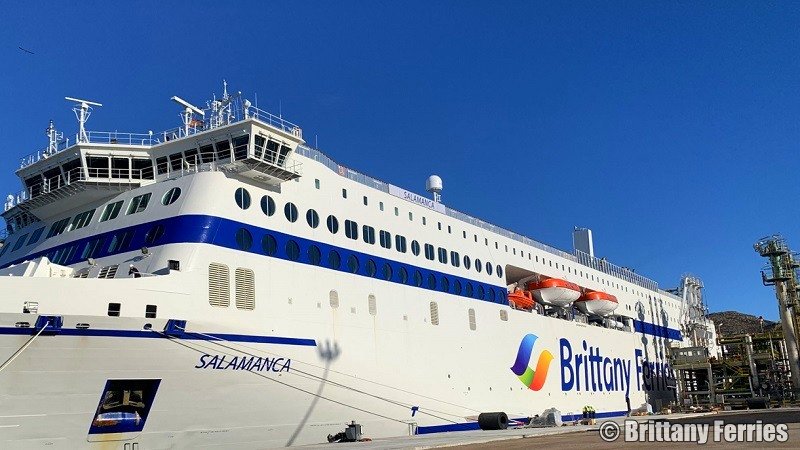
France | September 13, 2025 – In a move that may influence how maritime emissions are calculated and regulated across Europe, Brittany Ferries has released findings from a 12-month independent study showing that methane slip from its LNG-powered ship Salamanca is 50% lower than current regulatory estimates suggest.
The research, conducted in collaboration with French scientists and the national ecological agency ADEME, challenges long-held assumptions about LNG emissions and encourages a fresh look at how innovation is recognised in the energy transition.

Table of Contents
A Data-Driven Shift in Emissions Understanding
Led by Benoît Sagot, a lecturer and researcher at ESTACA, the study recorded real-time funnel emissions from Salamanca, one of Brittany Ferries’ four LNG-powered vessels. Over a full year of operations on the Rosslare–Bilbao and Rosslare–Cherbourg routes, researchers monitored methane slip — unburned methane released during combustion.
Key Finding: Methane slip was recorded at 1.57%, significantly below the 3.5% default value used in current European Union frameworks under the FuelEU Maritime and Emissions Trading System (ETS) regulations.
Published in the Journal of Marine Science and Engineering, the peer-reviewed study stands among the most comprehensive real-world LNG emissions monitoring efforts undertaken in European ferry operations.
A Call to Reflect Real-World Data
Brittany Ferries CEO Christophe Mathieu spoke openly about the broader implications of the findings, especially in relation to regulatory fairness and innovation:
“We fully support the established principle of polluter pays, but the rules must reflect reality,” said Christophe Mathieu, CEO Brittany Ferries. “The data now shows that real emissions from our LNG ships are far, far lower than initial fears. This must be woven into regulatory declarations, mindful that these must be the basis of fines we must pay.”
“This independent research has been peer reviewed and should therefore serve as a solid basis for European and international regulators,” he continued. “We have invested significantly in LNG as a cleaner, greener fuel with four new ships. It is important that we are recognised for our sector leading approach to sustainability, and that we are not penalised for phantom emissions that exist only on a spreadsheet.”
Mathieu’s remarks highlight an important issue for many shipowners: if emissions are calculated using outdated or overly conservative data, operators may face penalties for emissions that don’t actually occur—so-called “phantom emissions.”

LNG: Still a Bridge Fuel — and Now Better Understood
Liquefied Natural Gas (LNG) has been promoted as a transitional marine fuel — offering a cleaner alternative to conventional heavy fuel oils. Yet methane slip has remained a central point of concern due to methane’s higher global warming potential.
This new data, however, reinforces confidence in modern LNG technologies, showing that the most recent vessel designs can perform significantly better than historical averages.
Why this matters:
- It offers a new baseline for policy and taxation, based on operational data.
- It supports LNG’s role as a legitimate bridge in the decarbonisation pathway.
- It creates clearer distinctions between older and newer engine technologies.
Policy Implications: Encouraging Science-Based Regulation
As the shipping industry works to meet stricter EU environmental regulations, including the ETS and FuelEU Maritime, the accuracy of emissions data becomes increasingly important. Default emissions factors — while useful for standardisation — may not reflect advances in real-world vessel performance.
The company’s message is clear: data-led regulation can both support climate goals and encourage continued investment in low-emission technologies.
Openness and Transparency: A Collaborative Path Forward
Brittany Ferries has also shown a willingness to support further research efforts. The company notes that it is open to new studies involving its LNG-powered fleet and views collaboration as key to collective climate action:
“Brittany Ferries is pleased to have contributed to research undertaken in collaboration with ADEME (the French Agency for Ecological Transition). It says that the company is ready to welcome follow-up studies and is open to approaches to use its LNG-powered ships, in the spirit of transparency and collective action to tackle climate change.”
This proactive stance signals an industry-led push for greater transparency and more nuanced regulation that recognises innovation, rather than penalising it based on outdated metrics.
Why This Matters to the Bunkering and Maritime Sector
As Bunker Market, We see this as a pivotal moment in the broader energy transition. The findings validate what many in the LNG space have long claimed: modern LNG ships can—and do—perform significantly better than assumed.
Key takeaways:
- LNG remains a credible low-carbon fuel, especially in its latest technical forms.
- Real-world data should inform emissions regulation, not generalised estimates.
- Sustainability innovation deserves fair recognition in the policy landscape.
For fuel suppliers, vessel operators, and policymakers alike, this is a moment to align strategy with science.
Final Thoughts: A Fairer Path to Net Zero
Brittany Ferries’ leadership in supporting project, this data sets an important precedent. As shipping navigates the complexities of climate compliance, the path forward must be grounded in verified performance, technological progress, and a shared commitment to transparency.
Reaching net zero won’t just require better fuels — it will require better frameworks. And that begins by ensuring those who invest in cleaner shipping technologies are measured by the emissions they actually produce — not by estimates from a decade ago.
About Brittany Ferries
Brittany Ferries was founded in 1972 by Alexis Gourvennec, a Breton farmer, along with a group of fellow agricultural producers. Their goal was to establish a direct shipping link between Brittany and the United Kingdom to export regional produce such as cauliflowers and artichokes. When existing shipping companies showed no interest, they took the initiative themselves—chartering the converted tank carrier Kerisnel and launching the first sailing from Roscoff to Plymouth on January 2, 1973.
What began as a freight operation quickly evolved into a broader travel enterprise, with growing demand from British tourists eager to visit Brittany. Over time, Brittany Ferries expanded into passenger transport and tourism services, becoming one of Europe’s leading ferry operators. Today, the company runs a modern fleet—including LNG-powered vessels—serving routes between France, the UK, Ireland, and Spain, and remains committed to innovation, sustainability, and enhancing cross-channel connectivity.
Source Brittany Ferries