
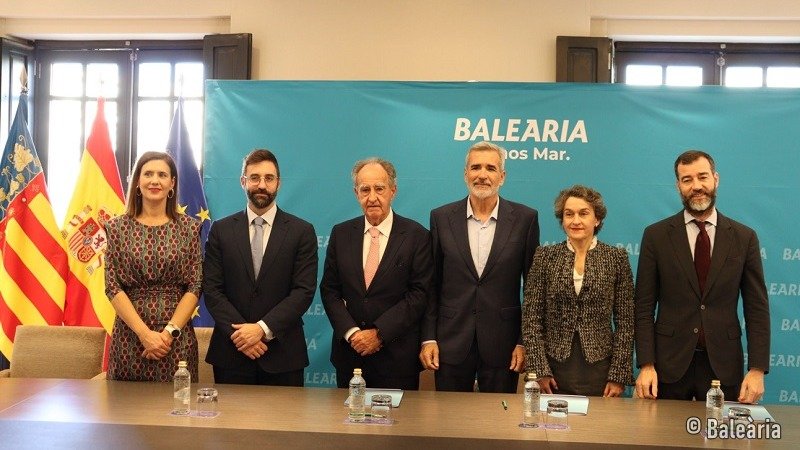
VALENCIA, SPAIN – December 12, 2025 – A landmark collaboration between Baleària and the port authorities of Valencia (APV) and Palma (APB) is set to create Spain’s first maritime green corridor, aiming for zero emissions by 2030 on the critical Valencia-Palma route.
The collaboration agreement, signed today by the presidents of the three entities, establishes a public-private partnership focused on rapid maritime-port decarbonisation through the joint use of next-generation low-carbon fuels and innovative port infrastructure.
The project was officially launched in Valencia with the participation of high-level government officials, including Joan Groizard, Secretary of State for Energy, and Benito Núñez, Secretary General of Air and Maritime Transport.
Table of Contents
Baleària’s Two-Pronged Decarbonisation Strategy
The ferry operator, Baleària, will dedicate two of its existing dual-engine ships to the Valencia-Palma line. The company plans to completely decarbonise the route by 2030 using a two-pronged approach:
- Fuel Transition: The vessels will transition to consuming 100% biogas by the 2030 deadline, achieving zero tailpipe emissions on the route.
- Electrification and OPS: Baleària will incorporate on-board batteries to supply renewable electricity for auxiliary uses during navigation and install Onshore Power Supply (OPS) connection systems on the vessels to allow for zero-emission stays in port.
Adolfo Utor, President of Baleària, stressed the pioneering nature of the commitment:
“This is a sustainable competitive commitment, which will be two decades ahead of the goal of zero emissions by 2050. The Valencia-Palma route will be the first green corridor between two Spanish ports. This public-private agreement will represent a significant advance in the mobility of passengers and essential goods between the Peninsula and the Balearic Islands.”
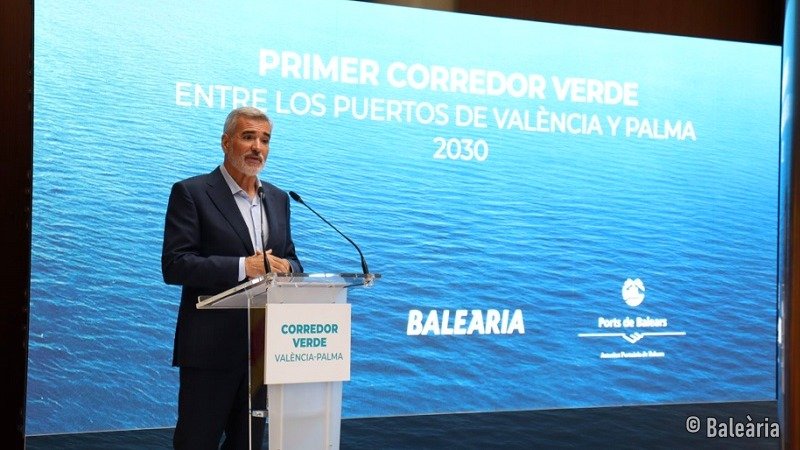
Port Authorities Accelerate Infrastructure
In line with their own Net Zero Emissions plans, the Port Authorities of Valencia and the Balearic Islands (Palma) will play a crucial role by accelerating the necessary shoreside infrastructure.
- Both ports will facilitate the construction of infrastructures capable of charging ship batteries while docked.
- The authorities will actively explore the availability and development of low-carbon fuel supplies to meet the growing demand created by the corridor.
Javier Sanz, President of the Port Authority of the Balearic Islands, highlighted the environmental responsibility: “Protecting our sea and our cities is compatible with port development; in fact, it is a condition for sustainable development. The ports of the Balearic Islands have the responsibility and the opportunity to lead the transition towards cleaner and quieter maritime activities.”
Mar Chao, President of Valenciaport, added that the corridor “reinforces the leadership of the company that promotes it, and contributes to strengthening the strength of the port community of Valenciaport in the decarbonisation process that unites us.”
Government Backing for Energy Transition
The project received strong backing from the central and regional governments, underscoring its national importance.
Joan Groizard, Secretary of State for Energy, confirmed the government’s commitment to maritime transition: “We are planning a major electrification of ports, and we are promoting the penetration of renewables in maritime transport. Winds of favour are now blowing to strengthen an investment full of future.”
Susana Camarero, First Vice-President of the Generalitat Valenciana, praised the regional leadership: “This project is a commitment to the future that unites territories, economies and a way of comparing progress from sustainability, innovation and responsibility.”
The green maritime corridor will play a vital role in advancing emission-free mobility for both passengers and essential goods between mainland Spain and the Balearic Islands.
The Port Authority of Valencia (APV) / Valenciaport
Valenciaport is the public body responsible for managing the ports of Valencia, Sagunto, and Gandía. As Spain’s leading Mediterranean port in terms of commercial traffic and the country’s largest container port, Valenciaport is a vital gateway for production and consumer goods to and from the entire Iberian Peninsula, serving a direct area that generates over half of Spain’s GDP.
The Port Authority is actively pursuing its Net Zero Emissions Plan, aligning its infrastructure investments, such as the new North Terminal, with sustainability goals and positioning itself as a leader in global logistics and the development of green corridors.
The Port Authority of the Balearic Islands (APB)
The APB manages the five ports of general interest in the Balearic archipelago, with Palma being the largest and a critical hub for both commercial cargo and passenger transport, including regular ferry services and cruise traffic. The APB oversees over 16 million tonnes of cargo and 9.4 million passengers annually.
Given the sensitive island environment, the APB’s commitment to the green corridor is central to its mission of integrating environmental, social, and governance (ESG) criteria into all operations, ensuring the protection of the sea and cities is compatible with necessary maritime activities.
About Baleària
Baleària is the leading Spanish shipping company specializing in the maritime transportation of passengers, vehicles, and goods. Founded in June 1998 and headquartered in Dénia, Alicante, Spain, the company is a benchmark for sustainability and innovation in the sector.
Key Information:
- Primary Business: Scheduled maritime transport of passengers, vehicles, and goods (ferry services).
- Geographic Focus: The company is the market leader in connections between mainland Spain and the Balearic Islands (and inter-island connections), as well as routes to the Canary Islands, Ceuta, and Melilla. Internationally, it operates services to North Africa (Morocco and Algeria) and connects the USA and the Bahamas (as Baleària Caribbean).
- Fleet & Scale (Approximate Figures):
- Fleet Size: Around 40 vessels.
- Routes: Operates approximately 28 routes connecting 5 countries.
- Passenger Traffic (2024): 5.6 million passengers.
- Cargo Traffic (2024): 7.6 million linear meters of cargo.
- Pioneering in Sustainability & Bunkering:
- Baleària is a pioneer in the use of Liquefied Natural Gas (LNG) as a marine fuel in the Spanish market, with an investment of over €500 million in dual-fuel engine ships.
- The company is actively testing and adopting renewable fuels, notably moving ships to run on bioLNG to further reduce its carbon footprint.
- It is committed to the goal of zero emissions by 2050 and is developing projects like the first fully electric, zero-emission intercontinental ferry route (Tarifa-Tangier Ville), set to launch new electric fast ferries.
- Its sustainability strategy includes building a modern, eco-efficient fleet, with an overall planned investment of €1 billion in a sustainable fleet between 2017 and 2028.
- Recent Developments: The company has recently been expanding its Spanish maritime network through the agreement to acquire core business operations of Armas Trasmediterránea, pending regulatory approval.
Source: Baleària Group