
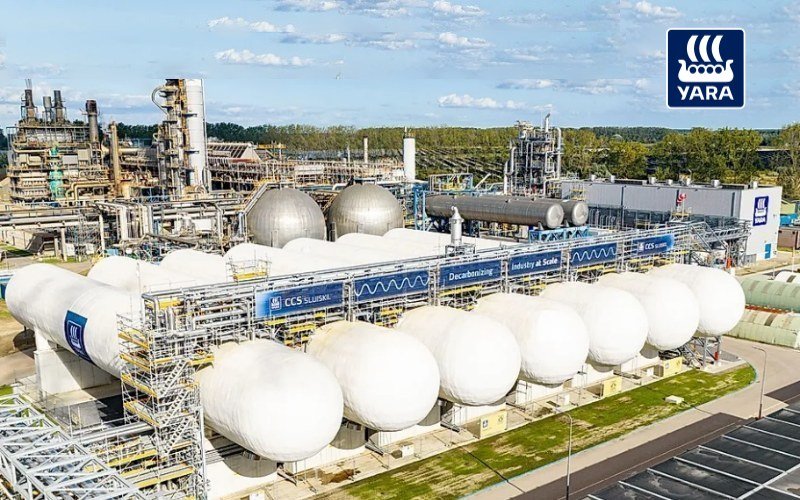
Yara has officially inaugurated Europe’s largest industrial carbon capture facility at its Sluiskil plant in the Netherlands, capturing up to 800,000 tons of CO₂ annually from ammonia production. The project establishes the continent’s first complete cross-border CCS value chain, utilizing specialized Northern Lights vessels to transport the liquefied carbon to Norway for permanent subsea storage 2,600 meters beneath the seabed. Expected to store around 12 million tons of CO₂ over the next 15 years, the initiative plays a critical role in driving down industrial emissions while supporting low-carbon products, including sustainable marine fuels for the shipping sector.
Sluiskil, The Netherlands | September 7, 2026 – Europe’s largest industrial carbon capture facility has officially been inaugurated at Yara’s plant in Sluiskil, Netherlands, establishing the continent’s first complete, cross-border value chain for capturing, transporting, and permanently storing carbon dioxide (CCS).
The high-profile inauguration brought together a prominent delegation of European and national leaders, including Norwegian Prime Minister Jonas Gahr Støre, Dutch Prime Minister Rob Jetten, European Commissioner for Climate, Net Zero and Clean Growth Wopke Hoekstra, and Yara International President and CEO Svein Tore Holsether.
The milestone facility enables Yara Sluiskil, Europe’s largest ammonia and fertilizer plant, to capture and liquefy up to 800,000 tons of CO₂ annually from its existing ammonia production processes, effectively avoiding carbon taxation on those volumes.
Cross-Border Transport and Permanent Subsea Storage
Under the operational framework, the captured CO₂ is temporarily stored on-site at Sluiskil before being loaded onto specialized Northern Lights vessels. The carriers transport the liquefied carbon across maritime borders to Øygarden, Norway, where it is injected and permanently sequestered 2,600 meters beneath the seabed.
Backed by strong framework conditions, the project is projected to capture and store approximately 12 million tons of CO₂ over the next 15 years, marking a monumental step forward for European climate compliance and industrial decarbonization.
“This is an important day for Yara and for European industry,” says Svein Tore Holsether, President and CEO of Yara International. “The carbon capture facility in Sluiskil proves that large-scale industrial decarbonization is possible today. As global competition intensifies, Europe must find ways to cut emissions while keeping industry, jobs and critical value chains in Europe.”
Enabling Low-Carbon Maritime Fuels and Value Chains
For the maritime and energy sectors, the project holds profound strategic value. The large-scale deployment of CCS directly enables Yara to drive down the carbon footprint of its core outputs, facilitating the commercial scaling of:
- Low-carbon marine fuels for the shipping sector
- Clean energy solutions and industrial-grade low-carbon ammonia
- Sustainable, low-carbon fertilizers to support eco-friendly agricultural supply chains
Tim Heijn, Managing Director of Northern Lights, highlighted the collaborative nature of the achievement: “Together, we are demonstrating that capture and cross-border CO₂ transport and storage is a viable solution for European industry. This is an important step in the development of Europe’s carbon management market and shows what is possible when industry and governments work together.”
Quick Facts: Yara & Northern Lights CCS Project
- Capture Capacity: Up to 800,000 tons of CO₂ annually from ammonia production at Yara Sluiskil.
- Logistics Chain: Liquefied on-site, transported via Northern Lights shipping to Øygarden, Norway.
- Storage Destination: Permanently sequestered 2,600 meters beneath the seabed.
- 15-Year Projection: Estimated 12 million total tons of CO₂ captured and stored.
About Yara
Yara is a global leader in crop nutrition and ammonia with a mission to responsibly feed the world and protect the planet. Yara operates a global, flexible production system that delivers a diversified portfolio of nitrogen-based products. With our extensive global market reach and more than a century of agronomic knowledge and continuous innovation, we partner across the value chain to improve crop yields, optimize resource use, and reduce environmental impact.
Through diversified energy exposure and profitable decarbonization efforts, Yara is uniquely positioned to strengthen industrial competitiveness and create long-term value for customers, shareholders, employees, and society at large. Founded in Norway in 1905, Yara operates in over 60 countries and serves more than 140 markets, employing about 15,700 people. In 2025, Yara reported revenues of USD 15.7 billion.
Source: Yara