Clean Arctic Alliance calls for urgent IMO global scrubber regulations to end the “toxic black hole” of wastewater discharge. Following the PPR13 meeting, NGOs warn that unified international standards are the only way for shipowners to navigate the rising tide of regional bans.
London | February 10, 2026 – The maritime industry is facing a pivotal moment in its transition toward cleaner operations as a coalition of environmental organizations ramps up pressure for a global mandate against scrubber wastewater discharge.
Following a high-profile event at the International Maritime Organization (IMO) headquarters on February 9th, the Clean Arctic Alliance issued a stern call for immediate international regulation. The alliance argues that the current “black hole” in global oversight has created a fragmented regulatory landscape that is becoming increasingly untenable for shipowners.
The Rise of “SWAG”: A Unified Front
The momentum shifted this week during the IMO’s Pollution Prevention and Response meeting (PPR13). An informal but influential group of approximately 20 ambitious Flag States and the European Commission, dubbed the Scrubber Water Action Group (SWAG), convened to address the environmental fallout of Exhaust Gas Cleaning Systems (EGCS).
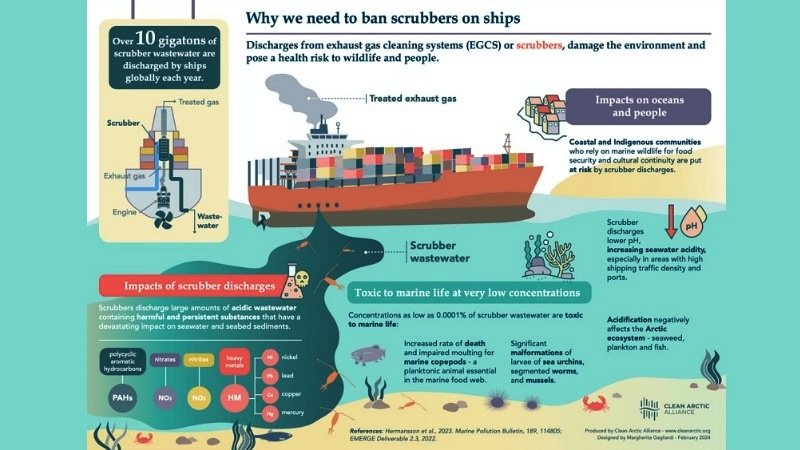
Scrubbers were originally championed as a way for vessels to meet sulfur emission caps while continuing to burn cheaper, high-sulfur heavy fuel oil (HFO). However, the systems function by “washing” the sulfur out of exhaust fumes and discharging the resulting acidic, toxic cocktail of heavy metals and polycyclic aromatic hydrocarbons (PAHs) directly into the sea.
A Fragmented Landscape
Dr. Kåre Press-Kristensen of Green Global Future highlighted the primary operational risk for the industry: a “patchwork quilt” of rules.
“Due to the IMO’s failure to regulate harmful discharges, we are seeing a surge in local, national, and regional authorities introducing their own bans,” Press-Kristensen noted. “Shipowners will find it increasingly difficult to navigate a world with constantly changing regulations. The only way out of this mess is rapid, ambitious IMO regulation.”
Closing the “Black Hole”: Dr. Sian Prior on Global Oversight
In reaction to the recent developments at the IMO, Dr. Sian Prior, Lead Advisor to the Clean Arctic Alliance, emphasized the danger of the current legislative vacuum:
“The Clean Arctic Alliance welcomes the work of this important informal group of about 20 ambitious Flag States and the European Commission which includes, as part of its common purpose, the encouraging of more states to take action to limit adverse effects of scrubbers. Currently there is no global regulation addressing the management of scrubber wastewater, this black hole in the IMO’s efforts to manage and reduce the impact of global shipping on ocean health must be urgently addressed.”
The Case for Global Regulation: Eelco Leemans on Ocean Health
Addressing the broader environmental and industry implications, Eelco Leemans, Technical Advisor to the Clean Arctic Alliance, called for a definitive shift away from fossil-fuel reliance:
“During this week’s meeting, IMO member states must agree that scrubber discharge water seriously affects aquatic ecosystems and therefore agree that not only do coastal states have the right to restrict or ban the discharges in their waters, but that global regulation is urgently needed, without global regulation it is not possible to adequately protect ocean health. Scrubbers at present justify the continued use of heavy fuel oil (HFO), the dirtiest of all fuels. The shipping industry should get their act together by rapidly moving away from HFO and from fossil fuels in the longer term.”
Enforcement: Debunking the Complexity Myth
One of the most significant developments from the PPR13 side-event, hosted by Denmark and the OSPAR Commission, was a presentation from France. French officials demonstrated that enforcing scrubber discharge bans is neither technically prohibitive nor administratively burdensome.
The Alliance pointed to the French model as proof that “enforcement issues” are no longer a valid excuse for legislative inertia. If a committed Flag State can efficiently monitor and penalize illegal discharges, the NGOs argue, there is no reason the IMO cannot scale these practices globally.
The “HFO” Sticking Point
Beyond the immediate toxicity of the wastewater, the Clean Arctic Alliance views scrubbers as a mechanical loophole that allows the shipping industry to cling to the “dirtiest fuel on the planet.”
Eelco Leemans, Technical Advisor to the Clean Arctic Alliance, was blunt in his assessment of the industry’s trajectory:
- The Problem: Scrubbers justify the continued use of Heavy Fuel Oil (HFO).
- The Solution: A rapid shift away from HFO in the short term and a complete exit from fossil fuels in the long term.
- The Mandate: Recognizing that coastal states have the right to protect their waters, but acknowledging that ocean health cannot be safeguarded without a global standard.
The Path Forward: MARPOL Annex VI
At the heart of the current negotiations is a push to amend MARPOL Annex VI. The Alliance is urging member states to:
- Restrict Scrubbers in PSSAs: Facilitate bans in Particularly Sensitive Sea Areas.
- Extend to ECAs: Consider widening the scope of discharge restrictions to all Emission Control Areas.
As PPR13 continues this week in London, the eyes of the bunkering and shipping world remain fixed on the IMO. With 24 non-profit organizations backing the Clean Arctic Alliance, the pressure is on for a decision that could effectively signal the beginning of the end for open-loop scrubbers on the high seas.
About the Clean Arctic Alliance
The Clean Arctic Alliance is an international coalition of 24 non-profit organizations dedicated to protecting the Arctic ecosystem, its wildlife, and its people from the environmental impacts of global shipping. By advocating for tighter international regulations, the Alliance aims to mitigate the most significant threats to the region: the use of heavy fuel oil (HFO), black carbon emissions, and the discharge of toxic waste.
Key Campaign Pillars:
- The HFO Phase-Out: Campaigning for a legally binding global ban on the use and carriage of heavy fuel oil in Arctic waters to prevent devastating oil spills.
- Black Carbon Reduction: Pushing for the adoption of “Polar Fuels”, distillate fuels that significantly reduce the “sooting” effect that accelerates ice melt.
- Scrubber Bans: Eliminating the “black hole” in maritime law that allows vessels to dump acidic wastewater from Exhaust Gas Cleaning Systems (EGCS) into sensitive marine environments.
- Underwater Noise: Addressing the acoustic disturbance from shipping that disrupts Arctic marine mammal migration and communication.
Membership & Reach: The Alliance represents a diverse global front, including members such as Greenpeace, WWF, Ocean Conservancy, Transport & Environment, and Friends of the Earth. Through technical advisory at the International Maritime Organization (IMO) and collaboration with Arctic indigenous communities, the Alliance serves as a leading voice for a sustainable, fossil-fuel-free maritime future.
“The Arctic is changing rapidly, and what happens in the Arctic doesn’t stay in the Arctic. Protecting this region is a global climate priority.” — Dr. Sian Prior, Lead Advisor.
Source: Clean Arctic Alliance