
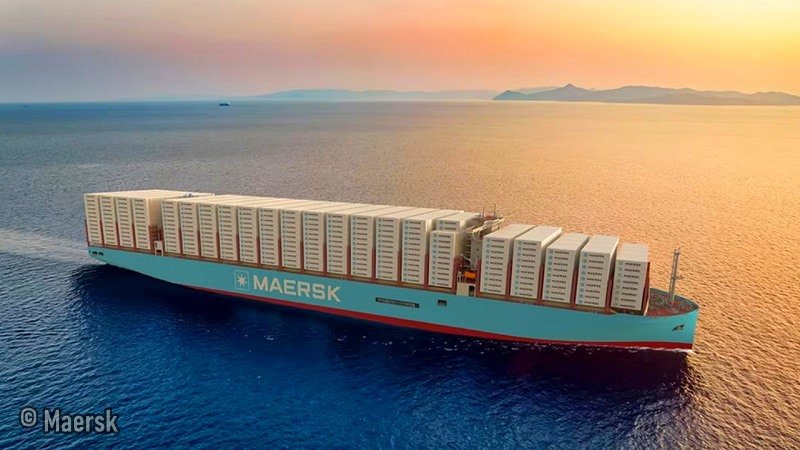
Maersk signs agreement with New Times Shipbuilding for eight large LNG dual-fuel vessels to be delivered in 2029 and 2030, with deployment flexibility.
Conpenhagen | February 9, 2026 – In a significant move to bolster its mid-to-long-term fleet competitiveness, A.P. Moller – Maersk (Maersk) has finalized a contract with China’s New Times Shipbuilding Co. Ltd. for the construction of eight large container vessels. The deal, announced on February 9, 2026, marks a strategic evolution in the Danish carrier’s decarbonization journey, opting for dual-fuel gas propulsion for this specific series.
The vessels are slated for delivery across 2029 and 2030. This order is a cornerstone of Maersk’s ongoing fleet renewal program, which seeks to replace aging, less efficient tonnage with modern, “future-proof” assets without expanding the total fleet capacity beyond the current target of 4.3 million TEU.
Technical Specifications: The Shift Toward “Deployment Flexibility”
While the industry has recently trended toward “Megamax” vessels exceeding 24,000 TEU and 400 meters in length, Maersk has opted for a more versatile design for this series.
| Feature | Specification |
| Capacity | 18,600 TEU |
| Length Overall (LOA) | 366 Meters |
| Breadth (Beam) | 58.6 Meters |
| Propulsion | Dual-fuel (Conventional Bunker / Liquefied Gas) |
| Delivery Window | 2029 – 2030 |
The choice of a 366-meter hull is strategic. By remaining more compact than the 400-meter giants, these ships gain access to a wider array of ports and terminals globally, providing Maersk with what Anda Cristescu, Head of Chartering & Newbuilding, calls “multiple deployment options” across both current and future network configurations.
A “Fuel-Agnostic” Turn: From Methanol to Methane
For several years, Maersk was synonymous with a “methanol-first” strategy. However, this latest order confirms a pragmatic shift toward a diversified fuel portfolio. These eight vessels will be equipped with dual-fuel engines capable of running on liquefied gas (including LNG and bio-methane).
“The order is part of our ongoing fleet renewal and helps maintain our fleet’s competitive edge,” stated Anda Cristescu, Head of Chartering & Newbuilding at Maersk. “Deployment flexibility has been a key factor, they offer greater flexibility than the largest ships currently being built in our industry.”
This pivot reflects a broader market reality:
- Availability: Ensuring fuel security as the supply of green methanol scales slower than anticipated.
- Bio-LNG Pathway: Maersk has recently been securing offtake agreements for liquified bio-methane (bio-LNG) to ensure these gas-enabled vessels meet the company’s 2040 net-zero targets.
Maersk’s Growing Orderbook
Following this agreement, Maersk’s total orderbook now stands at 33 vessels. The company is maintaining a rigorous delivery schedule to ensure its 2030 science-based targets (SBTi) remain achievable.
- Remaining 2026 Deliveries: 4 vessels are still scheduled for handover this year.
- Total Dual-Fuel Goal: By the time this latest series is fully integrated in 2030, approximately 25% of Maersk’s fleet will be equipped with dual-fuel engines.
2040 Net-Zero Ambition
Maersk continues to lead the industry with its goal of reaching net-zero GHG emissions by 2040. The company defines “reduced GHG emissions fuels” as those achieving at least a 65% reduction on a lifecycle basis compared to fossil fuels (94 g CO2e/MJ). While these new ships can burn conventional bunkers today, their dual-fuel capability allows them to transition seamlessly to bio-LNG as the regulatory landscape, such as the EU Emissions Trading System (ETS) and FuelEU Maritime, tightens.
About A.P. Moller – Maersk
A.P. Moller – Maersk is a global leader in integrated logistics, committed to connecting and simplifying its customers’ supply chains. With operations in over 130 countries and a workforce of around 100,000 employees, Maersk is at the forefront of shipping, terminal operations, and logistics solutions.
The company is driving the transition to sustainable shipping, aiming to achieve net-zero GHG emissions by 2040 through investments in alternative fuels, energy-efficient vessels, and digital innovation with at least 65% lifecycle emissions reductions, and extensive efficiency measures such as this retrofit programme. Maersk is dedicated to shaping the future of global trade with end-to-end supply chain solutions that enhance efficiency, reduce costs, and promote environmental sustainability.
Source: Maersk