
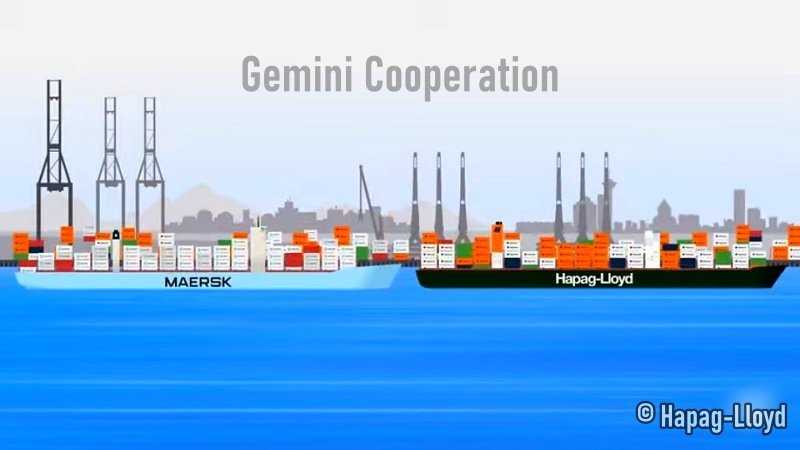
Hamburg | February 3, 2026 – In a significant shift for global trade lanes, Hapag-Lloyd and A.P. Moller – Maersk have announced they will begin transitioning select services under their Gemini Cooperation back to the Red Sea and Suez Canal corridor.
The move, effective mid-February 2026, marks the first time the alliance, launched exactly one year ago, will structurally utilize the Suez route for its shared network, which has largely circumvented the region since its inception due to security risks.
The IMX Service: The Strategic First Step
The first service slated for rerouting is the IMX service (also referred to as ME11 in some networks), a vital link connecting the Indian subcontinent and the Middle East with Mediterranean markets.
By returning to the Suez Canal, the carriers expect to slash transit times significantly. Industry analysts estimate the move could reduce round-trip durations by up to two weeks, effectively freeing up an estimated 31,000 TEU of capacity across the loop.
Implementation Schedule:
- Westbound Sailings: Transition begins with the vessel Albert Maersk (a 16,600 TEU methanol dual-fuel ship), expected to depart from Mundra, India, in mid-February.
- Eastbound Sailings: Transition begins with the vessel Astrid Maersk, departing from Valencia, Spain.
Security and Naval Protection
Both carriers emphasized that the safety of crews and cargo remains the “highest priority.” Consequently, all transits through the Red Sea will be conducted under naval assistance, likely coordinated with international missions such as the EU’s Operation Aspides.
“The highest possible security precautions will be undertaken, any alteration to the Gemini service will remain dependent on the ongoing stability in the Red Sea area and the absence of any escalation in conflicts in the region,” the companies stated in a joint advisory.
Future Expansions: SE1 and SE3 Services
The IMX rerouting is viewed as a test case for the wider Gemini network. Hapag-Lloyd and Maersk confirmed they are monitoring conditions to potentially transition the SE1 (AE12) and SE3 (AE15) services, which connect Asia with the Adriatic and Turkey, to the Suez route at a later stage.
Currently, no other changes to the 29 mainline and 29 shuttle services within the Gemini network are foreseen.
Impact on Schedule Reliability
Since its launch on February 1, 2025, the Gemini Cooperation has touted a “hub-and-spoke” model designed to achieve industry-leading schedule reliability. Recent data from the partners suggests the alliance has already maintained a reliability score of over 90%, even while navigating the longer Cape of Good Hope route. The return to Suez is intended to uphold these standards while offering customers faster delivery windows.
The Gemini Cooperation: A New Benchmark for Global Shipping
Launched with a focus on Reliability, Connectivity, and Sustainability, the Gemini Cooperation represents a transformative shift in the maritime industry. The alliance operates an extensive network covering seven major trades through 57 services, including high-frequency mainliners and dedicated shuttles, further supported by a robust feeder system. With a formidable fleet of approximately 340 modern vessels and a total capacity of 3.7 million TEU, Gemini is uniquely positioned to drive decarbonization, as many of its ships are already equipped to adopt cleaner alternative fuels.
The partnership’s “hub-and-spoke” operational model has already yielded historic results:
- Exceptional Reliability: In its initial months, the network achieved a schedule reliability of 92%, consistently maintaining scores above 90% across all alliance port calls.
- Vast Connectivity: The network connects 87 unique ports and offers over 6,000 port-to-port combinations, ensuring unparalleled global reach.
- Industry Leadership: By setting a new standard for consistency in an industry historically plagued by delays, the Gemini Cooperation is delivering on its promise to provide shippers with the most dependable logistics chain in the world.
About Hapag-Lloyd
With a fleet of 305 modern container ships and a total transport capacity of 2.5 million TEU, Hapag-Lloyd is a global leader in liner shipping. The company operates 130 liner services connecting more than 600 ports worldwide. Beyond the sea, its Terminal & Infrastructure segment holds equity stakes in 21 terminals across Europe, the Americas, India, and North Africa, supported by a global workforce of roughly 17,000 employees.
Source: Hapag-Lloyd