
Ålesund, Norway | January 26, 2026 – VARD, a premier subsidiary of the Fincantieri Group, has officially presented the findings of NuProShip II, a landmark research and innovation project that confirms the technical feasibility of integrating 4th-generation nuclear reactors into specialized offshore vessels. As the maritime industry grapples with the immense pressure of decarbonization, the “atomic option” is moving from theoretical physics to naval architecture through this groundbreaking study.
The project, titled “Nuclear Propulsion in Merchant Shipping,” represents a sophisticated pivot toward high-density, zero-emission power for complex marine operations.
Engineering the Atomic Construction Vessel
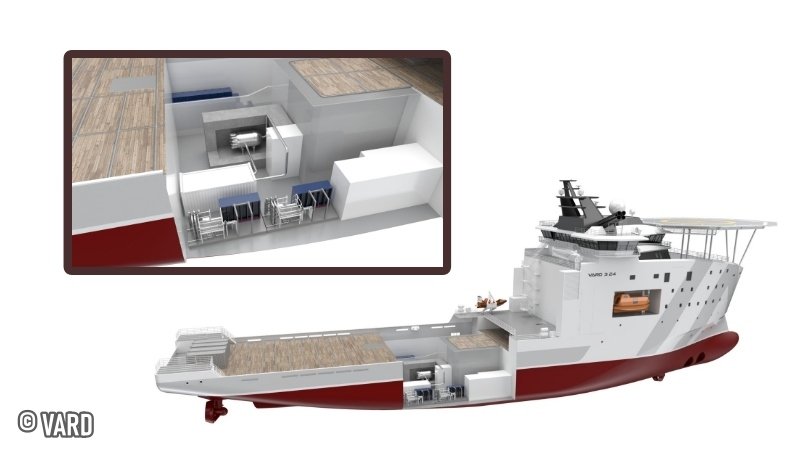
The centerpiece of VARD’s contribution is a conceptual design for a nuclear-powered offshore construction vessel. Leveraging an existing VARD reference design, engineers investigated the integration of a helium gas-cooled reactor as the primary energy source.
The study didn’t just look at the “plug-and-play” aspect of a reactor; it scrutinized the entire ecosystem of a nuclear ship:
- Vessel Layout: Managing the spatial requirements of shielding and reactor containment.
- System Performance: Evaluating how a nuclear thermal source interacts with marine propulsion.
- Redundancy: Ensuring the power architecture meets rigorous DP2 (Dynamic Positioning) standards, with the potential to scale to DP3 for ultra-critical operations.
“NuProShip II demonstrates that nuclear-powered vessels are not just a vision, but a technically feasible solution,” says Henrik Burvang, Research & Innovation Manager at Vard Design AS. “It is particularly valuable to have a professional operator like Island Offshore involved, proving that ship owners are seriously focusing on this technology.”

Beyond the Reactor: Heat and Storage
NuProShip II isn’t solely about the reactor; it explores how to harvest and manage massive amounts of thermal energy. The project highlights several “force multiplier” technologies:
- Super-critical CO₂ (sCO₂) Turbines: Offering higher efficiency and smaller footprints than traditional steam cycles.
- Thermal Battery Systems: Acting as energy buffers, these provide power balancing alternatives to conventional, and heavy, chemical electrical batteries.
- Extended Endurance: The ability to operate for years without refueling, fundamentally altering the logistics of the global bunkering infrastructure.
The Consortium of Innovation
The project’s strength lies in its multi-disciplinary backbone, led by the Norwegian University of Science and Technology (NTNU). Key partners include:
- DNV: Overseeing safety and regulatory frameworks.
- Emerald Nuclear: Providing reactor technology expertise.
- Vard Electro: Managing complex electrical integration.
- Island Offshore: Providing the shipowner’s pragmatic perspective.
Critical Challenges: Regulation and Perception
Despite the technical successes, the NuProShip II report is candid about the hurdles ahead. The transition to a nuclear-powered merchant fleet requires:
- Regulatory Evolution: A modern international framework for civilian nuclear propulsion.
- Public Trust: Transparent communication regarding radiological safety and environmental stewardship.
- Industrial Scale: Building the global supply chain and specialized bunkering facilities required for nuclear fuel cycles.
What’s Next: The SAINT Initiative
The conclusion of NuProShip II in 2026 marks the beginning of a much larger endeavor. The project will transition into the SFI SAINT (Sustainable Applied and Industrialized Nuclear Technology) center.
Led by NTNU with VARD as a core partner, the center has secured NOK 96 million from the Research Council of Norway, bolstered by approximately NOK 200 million in industrial contributions. This eight-year mission will focus on industrializing these concepts, ensuring that the next generation of maritime propulsion is not just sustainable, but transformative.
About VARD: A Global Leader in Specialized Shipbuilding
Headquartered in Ålesund, Norway, VARD is a premier global designer and shipbuilder of highly customized specialized vessels for the offshore, energy, and research sectors. As a core subsidiary of the Fincantieri Group, one of the world’s largest shipbuilding entities, VARD leverages a decentralized production network that includes major facilities in Norway, Romania, Brazil, and Vietnam.
The company employs approximately 8,000 professionals worldwide, providing end-to-end solutions that encompass advanced ship design, power and automation systems through Vard Electro, and high-end interior and HVAC solutions via Vard Interiors. With a legacy rooted in Norwegian maritime tradition, VARD is currently at the forefront of the industry’s “green transition,” spearheading innovations in hydrogen, ammonia, and nuclear propulsion to achieve zero-emission maritime operations.
Source: VARD Design AS