
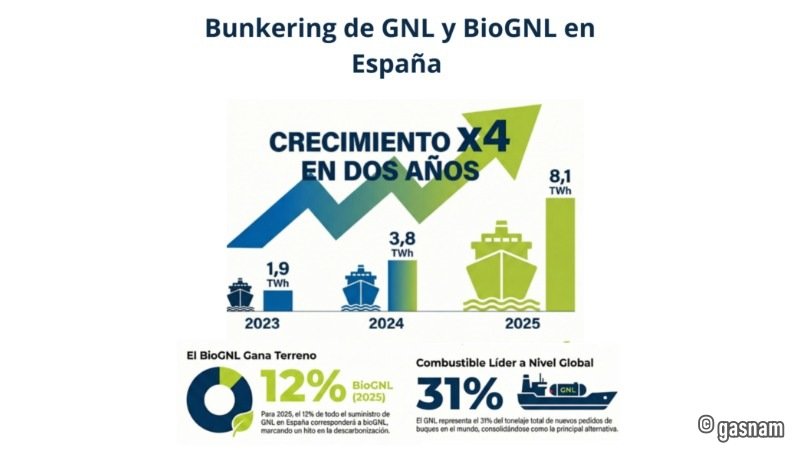
Madrid, Spain | January 21, 2026 – New data released by Gasnam-Neutral Transport confirms that the Iberian Peninsula has achieved a “industrial-scale” breakthrough in the alternative fuels market. In a landmark 24-month period, LNG bunkering volumes across Spanish ports have surged fourfold, exceeding 8.1 TWh in 2025.
The figures signal a definitive shift from trial operations to a mature, high-volume market, driven by the rapid expansion of the global dual-fuel fleet and the strategic positioning of Spanish and Portuguese ports as Tier-1 refueling hubs.
The Bio-LNG Breakthrough: Decarbonization in Action
Perhaps the most significant metric for shipowners navigating the FuelEU Maritime and EU ETS landscapes is the “greening” of the molecule. More than 12% of the total LNG supplied (approx. 970 GWh) was of renewable origin (Bio-LNG).
This 12% share represents a massive leap in carbon-neutral supply, equivalent to the energy required to fuel 16 million passenger vehicles. For the bunkering industry, this proves that the “drop-in” capability of Bio-LNG is no longer a pilot project but a commercial reality in the Mediterranean and Atlantic basins.
Structural Shift: STS Dominance and the “Sines” Milestone
The operational profile of Spanish bunkering has undergone a total transformation:
- Ship-to-Ship (STS) Hegemony: Reflecting the needs of Ultra-Large Container Vessels (ULCVs) and the cruise sector, STS operations now account for 80% of total deliveries, a dramatic rise from just 44% a year ago.
- The Portugal Factor: 2025 marked the formal entry of Portugal into the regional LNG infrastructure. The Port of Sines successfully executed 13 major operations totaling 342 GWh, primarily through STS transfers. This consolidates the Iberian Peninsula as a unified strategic enclave for the global merchant fleet.
| Year | Volume (Approx) | Operational Milestone |
| 2023 | 1.9 TWh | Early adoption; high Truck-to-Ship (TTS) ratio |
| 2024 | 3.8 TWh | Deployment of dedicated barges (Levante LNG) |
| 2025 | 8.1 TWh | STS Dominance (80%) and 12% Bio-LNG mix |
Global Fleet Dynamics: LNG Maintains its Lead
The local surge in Spain is mirrored by global shipbuilding trends. According to DNV data integrated into the report:
- Order Book Resilience: Despite a general slowdown in newbuilding orders, alternative fuel vessels maintained a 38% share of total Gross Tonnage (GT).
- Preferred Vector: LNG remains the primary choice for owners, representing 31% of the total GT on order (188 new vessels), with the container segment leading the charge.
- Fleet Growth: The global LNG-powered fleet expanded by 30% in 2025, with 193 new deliveries bringing the total operational and on-order count to nearly 1,500 vessels.
Supply Infrastructure: Closing the Gap
The “chicken-and-egg” infrastructure dilemma is officially over. To support the growing fleet, 22 new LNG Bunker Vessels (LNGBVs) were added to the global order book in 2025. Currently, the global supply network boasts:
- 62 LNGBVs in active operation.
- 38 LNGBVs currently on order.
Industry Outlook
As the industry moves deeper into 2026, the Spanish market’s evolution toward high-efficiency STS models and renewable Bio-LNG blends provides a blueprint for other global hubs. The infrastructure is now in place to support the industry’s transition toward absolute climate neutrality, proving that LNG remains the most scalable and viable pathway for the immediate future of shipping.
Source: Gasnam