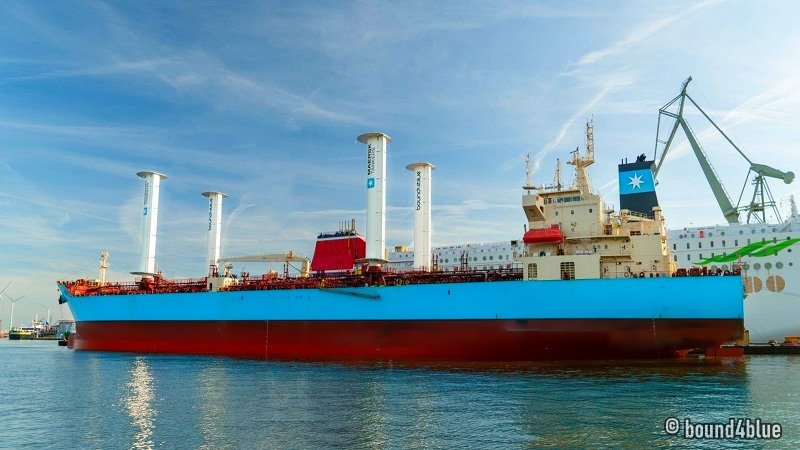
Barcelona, Spain | January 26, 2026 – In a defining moment for maritime decarbonization, bound4blue and Maersk Tankers have announced the successful installation of eSAIL® units on the Maersk Trieste. This marks the first delivery under a milestone agreement to deploy 20 suction sails across five advanced medium-range (MR) tankers, the largest order in bound4blue’s history.
The Maersk Trieste is now equipped with four 24-metre autonomous suction sails, a move heralded by industry leaders as a “watershed moment” for the integration of wind power into the global shipping fleet.
Table of Contents
The Technology: Suction Sails vs. Traditional Wind Power
Unlike traditional fabric sails or even rigid wing sails, bound4blue’s eSAIL® technology utilizes active aerodynamics. By using an internal fan to draw air across an aerodynamically optimized surface, the system generates a “suction” effect that keeps the boundary layer of air attached to the sail longer.
Key Benefits of eSAIL® Integration:
- Massive Lift: Generates up to seven times more lift than conventional rigid sails of a comparable size.
- Operational Simplicity: The system is fully autonomous, requiring zero crew interaction to optimize performance based on real-time wind conditions.
- Fuel & Emission Reductions: Delivers double-digit percentage savings in fuel consumption and CO2 emissions.
- Regulatory Edge: Significantly improves a vessel’s Carbon Intensity Indicator (CII) rating and unlocks “Wind Reward Factors” under FuelEU Maritime and EU ETS frameworks.
Tailored for Tankers: Overcoming Safety Barriers
The tanker segment presents unique integration challenges, particularly regarding hazardous zones and air draft limitations. bound4blue has addressed these through a non-ATEX (non-explosion proof) design that prioritizes both safety and cost-efficiency:
- Safety-First Geometry: By positioning the sail’s maintenance access door on the side, well above the deck’s hazardous zones, the system remains outside of ATEX-regulated areas. This eliminates the need for expensive explosion-proof modifications.
- Preserved Air Draft: The eSAIL® provides high performance without excessive height, allowing tankers to maintain their normal operational air draft and navigate critical canal networks without complex tilting mechanisms.
- Seamless Operations: The design ensures that wind propulsion can be adopted without altering the vessel’s standard operational profile or compromising payload safety.
A Global Logistics Success: China to Belgium
The installation followed a sophisticated two-step “plug-and-play” process designed by bound4blue and system integrator Njord to minimize vessel downtime:
- Stage 1 (Shenzhen, China): The Maersk Trieste underwent “wind-ready” preparations at Yiu Lian Shipyard, including the installation of deck pedestals and electrical modifications.
- Stage 2 (Antwerp, Belgium): The eSAIL® units were lifted and secured at EDR Shipyard, where they were connected to the ship’s power and data networks in less than a day.
“Our system was designed from day one to deliver maximum performance with minimum complexity,” said José Miguel Bermúdez, CEO and co-founder of bound4blue. “This is proof that wind propulsion is ready to deliver at scale, even for complex vessel types like tankers.“
The Wave of Adoption: From Niche to Mainstream
The Maersk Tankers project is the centerpiece of a broader “wind revolution” across the maritime industry. No longer an experimental concept, wind-assisted propulsion is becoming a bankable decarbonization tool for leading shipowners:
- Expanding Portfolio: This project follows high-profile contracts with Louis Dreyfus Company, Eastern Pacific Shipping, Odfjell, Klaveness Combination Carriers, and BW Epic Kosan.
- Industrial Scale: bound4blue is scaling its production capacity to meet growing global demand, with over 50 eSAILs® currently in its order book and dozens already deployed.
- Market Consensus: Tightening regulations and rising fuel costs have shifted industry sentiment, moving wind power from a “pilot project” phase to a standard component of modern fleet efficiency strategies.
| Partner | Vessel Type | Progress Status |
| Maersk Tankers | MR Tankers | 20 units (Rolling out) |
| Odfjell | Chemical Tankers | Installations completed |
| BW Epic Kosan | LPG Carriers | Installation scheduled 2026 |
| Eastern Pacific | MR Tankers | 3 units (Completed) |
The Strategic Vision for Maersk Tankers
For Maersk Tankers, this project is part of a broader commitment to tangible, scalable decarbonization.
Claus Grønborg, Chief Investment Officer at Maersk Tankers, said “For the tanker industry, progress on emissions reduction requires concrete investments and implementation. At Maersk Tankers, we focus on deploying advanced energy-efficient technologies to reduce fuel consumption and CO₂ emissions. Implementing Wind-Assisted Propulsion Systems at scale enables more energy-efficient voyages for our customers, while supporting compliance with FuelEU Maritime and the EU Emissions Trading System.”
| Feature | Impact on Fleet Operations |
| Safety | Non-tilting, non-ATEX design maintains normal air draft and safety standards. |
| Compliance | Directly supports IMO’s EEDI/EEXI targets and EU environmental mandates. |
What’s Next for bound4blue?
With this installation, bound4blue joins a growing wave of adoption among industry giants like Louis Dreyfus Company, Eastern Pacific Shipping, and Odfjell. The project proves that wind-assisted technology is no longer a niche innovation but a mainstream strategy for the maritime energy transition.
Source: bound4lbue