The Global Risks Report, the World Economic Forum’s annual snapshot of the biggest risks facing the world in the near, medium and long terms, shows geopolitical and economic risks on the rise in the new ‘age of competition’.
Geneva, Switzerland | 14 January 2026 – The World Economic Forum (WEF) has released its Global Risks Report 2026, highlighting the most significant challenges that leaders and experts expect to shape the world over the next decade. The report identifies geoeconomic confrontation as the top near-term risk, followed by state-based conflict, extreme weather, societal polarization, and misinformation.
Now in its 21st edition, the report highlights a sharp escalation in geopolitical, economic and technological risks, underscoring growing uncertainty in global governance, economic stability and social cohesion. The findings come just days ahead of the Forum’s 56th Annual Meeting in Davos, where world leaders will gather amid rising tensions and structural shifts in the global order.
Table of Contents
Global outlook turns increasingly turbulent
Surveyed leaders and experts paint a bleak picture of the near future. Half of respondents expect the world to be turbulent or stormy over the next two years, a 14-percentage-point increase from last year. Another 40% foresee an unsettled environment, while only 9% anticipate stability and just 1% predict a calm global outlook.
Looking further ahead, pessimism deepens. Over a 10-year horizon, 57% of respondents expect global conditions to be turbulent or stormy, 32% foresee instability, 10% expect stability and again only 1% anticipate calm.
The report concludes that the world is entering a new age of competition, where cooperation is increasingly strained by national interests, strategic rivalries and economic weaponization.
Geoeconomic confrontation tops global risks
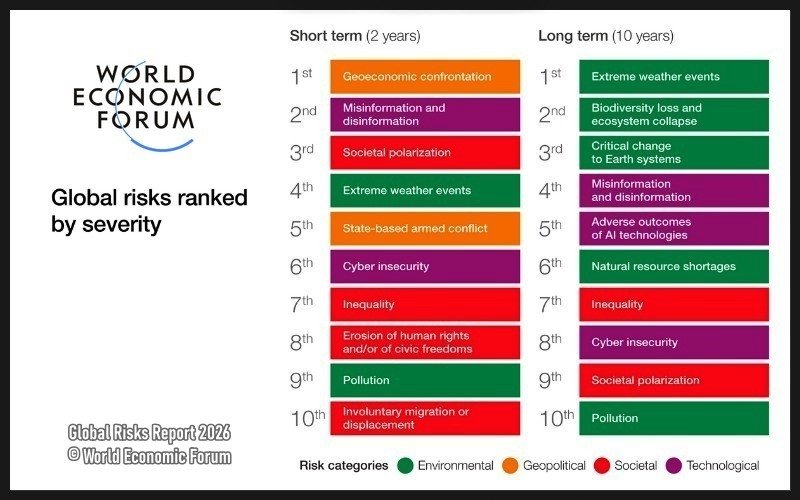
For the first time, geoeconomic confrontation has risen to the top of the near-term risk rankings. Eighteen percent of respondents identified it as the most likely trigger of a global crisis in 2026, while it also ranks first for severity over the next two years—climbing eight positions compared with last year.
This risk reflects growing tensions arising from sanctions, trade restrictions, industrial policy competition and the strategic use of economic tools by states. According to the report, such confrontations threaten global supply chains, financial stability and international cooperation, increasing vulnerability to economic shocks.
State-based armed conflict ranks second for 2026, though it drops to fifth place in the two-year outlook. The findings point to a world marked by prolonged conflicts and deepening rivalries, with 68% of respondents expecting a multipolar or fragmented global order over the next decade.
Economic risks rise fastest
Economic risks showed the largest collective increase in the two-year outlook. Economic downturn and inflation each surged eight positions, ranking 11th and 21st respectively. Meanwhile, the risk of an asset bubble burst rose seven positions to 18th.
Mounting public and private debt, combined with prolonged high interest rates and geoeconomic fragmentation, could trigger renewed market volatility. The report warns that economic shocks may become more frequent and harder to manage as coordination between major economies weakens.
Technology-driven anxiety intensifies
Technology-related risks remain a major concern. Misinformation and disinformation ranks second in the two-year outlook, while cyber insecurity ranks sixth.
The most dramatic rise is seen in risks linked to artificial intelligence. Adverse outcomes of AI climbed from 30th place in the two-year horizon to fifth place in the 10-year outlook, reflecting mounting anxiety over labour displacement, societal disruption, security threats and governance gaps.
Societal polarization and inequality persist
Societal polarization ranks fourth for 2026 and rises to third by 2028. Inequality remains a central concern, ranking seventh in both the two- and 10-year outlooks.
For the second consecutive year, inequality was identified as the most interconnected global risk, amplifying other challenges such as political instability, economic downturns and social fragmentation. Rising cost-of-living pressures and increasingly entrenched K-shaped economic recoveries continue to erode social cohesion.
Environmental risks decline short term, dominate long term
As immediate geopolitical and economic pressures dominate attention, environmental risks have declined in the short-term rankings. Extreme weather fell from second to fourth place, pollution dropped from sixth to ninth, while biodiversity loss and critical changes to Earth systems declined by five and seven positions respectively.
However, this shift reflects prioritization rather than reduced danger. Over the 10-year horizon, environmental risks remain the most severe globally. Extreme weather, biodiversity loss and critical changes to Earth systems occupy the top three positions.
Notably, three-quarters of respondents expect a turbulent or stormy environmental outlook, making it the most negative risk category assessed.
Leadership perspectives
Børge Brende, President and CEO of the World Economic Forum, said the findings reflect a profound transformation in global relations.
“A new competitive order is taking shape as major powers seek to secure their spheres of interest. This shifting landscape, where cooperation looks markedly different than it did yesterday, reflects a pragmatic reality: collaborative approaches and the spirit of dialogue remain essential.”
Saadia Zahidi, Managing Director at the Forum, emphasized the report’s role as an early-warning mechanism.
“The Global Risks Report offers an early warning system as the age of competition compounds global risks, from geoeconomic confrontation to unchecked technology to rising debt. But none of these risks are a foregone conclusion.”
About the Global Risks Report 2026
The Global Risks Report draws on insights from the Global Risks Perception Survey, incorporating views from more than 1,300 leaders and experts across business, government, academia, international organizations and civil society. The report aims to equip decision-makers with foresight to navigate immediate shocks and long-term structural challenges.
It is complemented by the Forum’s Scenarios for the Global Economy Dialogue Series, which explores future trajectories for the global economy, technology adoption and labour markets through 2030.
Davos Annual Meeting 2026
The findings will shape discussions at the World Economic Forum Annual Meeting 2026, taking place from 19–23 January in Davos-Klosters, Switzerland, under the theme “A Spirit of Dialogue.” The meeting will convene global leaders to address rising risks and identify pathways toward resilience in an increasingly fragmented world.
Source: World Economic Forum