
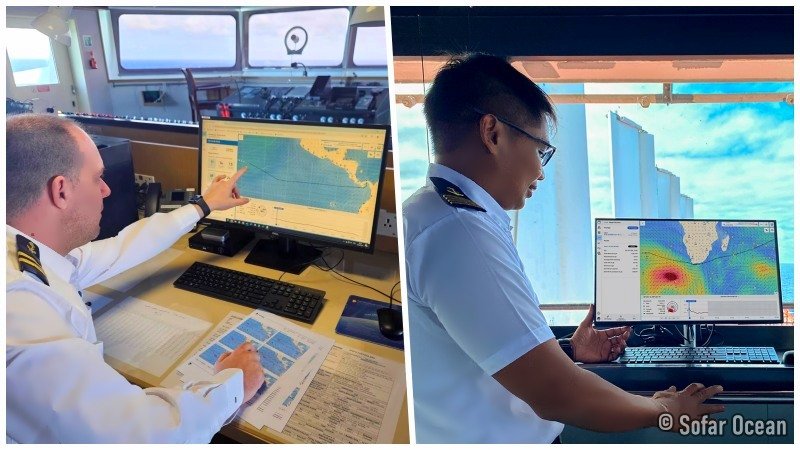
San Francisco, CA | January 14, 2026 – Sofar Ocean, the leading ocean intelligence platform, has released its 2025 Wayfinder Savings Report, documenting an average 6.9% fuel saving per voyage across its global maritime fleet. By leveraging the world’s largest real-time ocean sensor network, which delivers billions of proprietary data points, the company has enabled carriers to secure critical compliance wins and protect profit margins despite a year of historic geopolitical and environmental volatility.
According to the report, Sofar’s Wayfinder Platform delivered an average of 6.9% fuel savings per voyage for its maritime shipping clients in 2025. In an industry facing mounting regulatory pressure and fluctuating bunker prices, these efficiencies provided a critical buffer for global carriers.
Table of Contents
Key Performance Metrics for 2025
The report highlights significant economic and environmental outcomes achieved through dynamic voyage optimization:
- Average Fuel Savings: 6.9% per voyage.
- Average Financial Savings: $16,686 per voyage.
- Emissions Impact: 56 metric tons of CO2 avoided per voyage.
- Aggregate Impact: Total emissions saved in 2025 were equivalent to removing 37,100 cars from the road for one year.
Navigating a Year of “Chaos”
The maritime industry in 2025 was tested by a “perfect storm” of disruptions, including Red Sea conflict reroutings via the Cape of Good Hope, shifting trade policies, and increasingly extreme offshore weather patterns.
Despite these challenges, Wayfinder maintained consistent quarterly savings ranging from 6.7% to 7.4%. The report argues that real-time data-driven routing and RPM (revolutions per minute) guidance are no longer optional “extras” but essential tools for protecting margins when external risks multiply.
Industry Leaders Report Results
Leading global operators including Berge Bulk, Dorian LPG, Star Bulk, and MOL Group have integrated Wayfinder into their daily operations. The 2025 report includes specific “Customer Spotlights” that quantify the platform’s impact:
- Dorian LPG: Documented an average savings of $20,060 per voyage.
- Berge Bulk: Credited the platform with efficiency gains that enabled up to 14 additional sailing days per vessel per year.
“Wayfinder allows us to increase vessel utilization and efficiency, ensuring that we balance profitability with emissions reduction objectives,” noted a representative in the report.
The Technology: Proprietary Data vs. Public Models
As AI becomes ubiquitous in the maritime sector, Sofar Ocean emphasizes that the quality of optimization is dictated by the quality of the underlying data. Wayfinder differentiates itself by moving beyond standard public weather models:
- Real-Time Sensor Network: Leverages billions of proprietary measurements from Sofar’s global buoy network.
- Digital Twins: Utilizes ship-specific digital twins that are updated daily to model vessel performance across all sea states accurately.
- Dynamic Guidance: Provides continuous updates to captains and shore teams, rather than static pre-voyage plans.
Closing the Regulatory Gap
While international progress on a global Net-Zero Framework saw some delays in 2025, the report underscores that carriers are not waiting for mandates to act. By prioritizing voyage optimization, fleets are successfully using immediate technology to bridge the gap between decarbonization ambitions and current operational realities.
The full 2025 Wayfinder Savings Report, featuring in-depth market analyses and economic outcomes, is now available for industry professionals.
Spotlight on Sofar Ocean: The Data Powerhouse Behind Modern Maritime Intelligence
As the maritime industry shifts toward digital transparency and decarbonization, Sofar Ocean has emerged as a critical infrastructure provider. By bridging the gap between “guesswork” and “ground truth,” Sofar has built an ecosystem that serves as the central nervous system for ocean intelligence.
The Engine: The World’s Largest Real-Time Sensor Network
At the heart of Sofar’s value proposition is its proprietary hardware: the Spotter buoy. While traditional weather models rely heavily on satellite data and shore-based stations, Sofar has deployed hundreds of basketball-sized, solar-powered sensors across the global ocean.
- Billions of Measurements: The network captures more than 1.5 million real-time observations daily, including wave spectra, surface wind, sea surface temperature, and barometric pressure.
- Superior Accuracy: By assimilating this “ground truth” data into its proprietary weather models, Sofar delivers forecasts that are up to 50% more accurate than standard government or public models.
- A “Distributed” Paradigm: Unlike expensive, stationary moorings, Sofar’s sensors drift freely, providing a high-density data blanket across open-ocean regions where data was previously non-existent.
The Platform: Wayfinder
Sofar transforms these billions of data points into actionable insights through its Wayfinder Platform. This dynamic voyage optimization tool is designed specifically for the complexities of modern shipping:
- Vessel-Specific Digital Twins: Wayfinder creates a performance model for every ship, updated daily based on its actual operations and historical performance in various sea states.
- Dynamic RPM and Routing: Instead of a static pre-voyage plan, the platform sends daily guidance to captains and shore teams, adjusting speed (RPM) and heading in real-time as weather and market conditions shift.
- Climate Impact: By optimizing routes for efficiency rather than just distance, Sofar helps fleets achieve an average of 4–8% in fuel savings and emissions reductions.
Trusted by Global Stakeholders
Sofar Ocean’s data doesn’t just power shipping fleets; it serves the broader global scientific and governmental community:
- Shipping Giants: Used by MOL Group, Berge Bulk, Star Bulk, and Dorian LPG to protect margins and hit ESG targets.
- Governmental Agencies: Partners with the US National Hurricane Center (NHC) and NOAA to provide early warning data for extreme weather events.
- Climate Scientists: Offers a “Spotter Archive” for researchers to access historical ocean data, helping the world better understand the long-term impacts of climate change on our oceans.
The Future of Ocean Intelligence
As we look toward 2026 and beyond, Sofar Ocean continues to expand its reach. With the recent launch of the Wayfinder Voyage Simulator, the company is now enabling commercial teams to run thousands of “what-if” scenarios in seconds, ensuring that profitability and sustainability are considered long before a vessel even leaves the pier.
Source: Sofar Ocean