
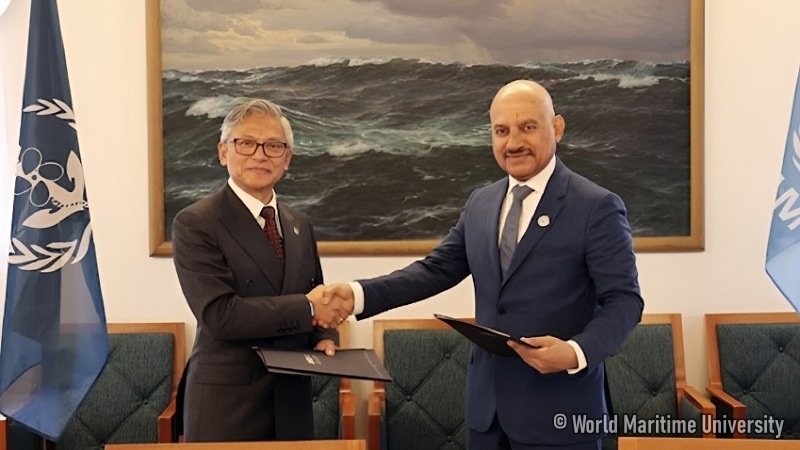
Malmö, Sweden | November 13, 2025 – In a move set to recalibrate the maritime research landscape of the Middle East, the World Maritime University (WMU) and Sharjah Maritime Academy (SMA) have formalized a sweeping strategic partnership. The agreement, signed on 12 November, marks a critical deepening of ties between the United Nations’ premier maritime educator and the UAE’s rapidly ascending hub for seafaring excellence.
The collaboration, signed by WMU President Professor Maximo Q. Mejia Jr. and SMA Chancellor Dr. Hashim Abdullah bin Sharhan Al Zaabi, comprises both a Memorandum of Understanding (MoU) and a detailed Collaborative Activities Agreement. For the marine fuel and shipping industries, the partnership signals a new era of data-driven insights into regional workforce planning and traffic safety.
A Bridge Between Global Standards and Regional Realities
The partnership is more than a diplomatic gesture; it is a tactical alignment. WMU, based in Malmö, Sweden, and operating under the auspices of the International Maritime Organization (IMO), brings unparalleled global academic authority. SMA, established in 2023, provides the regional “boots on the ground” and state-of-the-art simulation facilities in Khorfakkan.
“This partnership will deepen our academic impact and support the professional development of maritime leaders in the Gulf—a region that is increasingly shaping the future of global shipping,” noted President Mejia.
The 2025-2026 Research Agenda: Three Pillars of Innovation
At the heart of the deal is a rigorous research program scheduled for rollout over the next two years. For stakeholders in the bunkering and logistics sectors, the three joint projects address systemic risks and transitions currently facing the industry:
- The Dhow Project: A unique study into informal, sail-powered maritime transport in the Indian Ocean. Understanding these traditional networks is vital for regional security and comprehensive traffic management in corridors where small-scale trade intersects with global shipping lanes.
- The Seafarer Supply Project: Addressing the critical global shortage of skilled personnel, this project will focus on global workforce planning and training systems. With the industry pivoting toward alternative fuels and digitalization, this research aims to ensure the “just transition” of the maritime labor force.
- Proactive Maritime Traffic Management: As vessel density in the Gulf and Hormuz regions increases, this project will develop risk-based models to enhance traffic safety, potentially reducing the likelihood of costly maritime incidents and environmental hazards.
Strengthening the UAE’s “Blue Economy”
The timing of this agreement aligns with the UAE’s strategic mission to emerge as a global leader in the sustainable blue economy. Chancellor Al Zaabi emphasized that the collaboration is specifically designed to produce graduates who are “grounded in UAE industry realities and empowered with global competence.”
The partnership leverages the unique institutional strengths of both organizations:
- Operational Roles: Under the agreement, WMU will spearhead academic oversight and global research standards, while SMA serves as the primary engine for regional implementation and specialized training.
- Institutional Framework: The collaboration bridges the World Maritime University’s (WMU) United Nations-level oversight via the IMO with the Sharjah Maritime Academy’s (SMA) domestic mandate under the UAE Ministry of Education and the Ministry of Energy and Infrastructure.
- Strategic Focus: While WMU provides the global blueprint for maritime policy and sustainable development, SMA focuses on technical excellence and building national capacity within the Gulf region.
- Geographic Synergy: The pact connects the long-standing maritime academic traditions of Malmö, Sweden, with the emerging industrial hub of Khorfakkan, UAE.
Industry Impact: Looking Ahead
For the marine fuel industry, the WMU-SMA nexus is expected to yield high-impact data on the evolution of shipping routes and the readiness of the regional workforce to handle the next generation of vessel technologies. As the UAE prepares for a pivotal 2026 in maritime logistics, the integration of IMO-level research into regional training suggests that Sharjah is no longer just a participant in global shipping, but a primary architect of its future.
About the Sharjah Maritime Academy (SMA)
Established in 2023, the Sharjah Maritime Academy is the UAE’s premier institution for maritime excellence. Located in the strategic port city of Khorfakkan, the Academy operates with the mandate of the UAE Ministry of Education and the Ministry of Energy and Infrastructure.
SMA holds the distinction of being the only institution in the UAE to offer CAA-accredited maritime bachelor’s degrees and is a certified National Qualifications Centre (NQC) provider. By combining advanced simulation technology with world-class instruction, SMA delivers internationally recognized Certificates of Competency (CoC) in strict accordance with IMO standards, ensuring its graduates are equipped to lead the transformation of the global blue economy.
About the World Maritime University (WMU)
Founded in 1983 within the framework of the International Maritime Organization (IMO), a specialized agency of the United Nations, the World Maritime University serves as the global pinnacle of postgraduate maritime education and research. Based in Malmö, Sweden, WMU is dedicated to building global institutional capacity and promoting the sustainable development of the world’s oceans. As a center of excellence, the university is a key driver of the UN 2030 Sustainable Development Agenda, fostering the leadership and innovation required to secure a sustainable future for the international maritime community.
Source: World Maritime University