
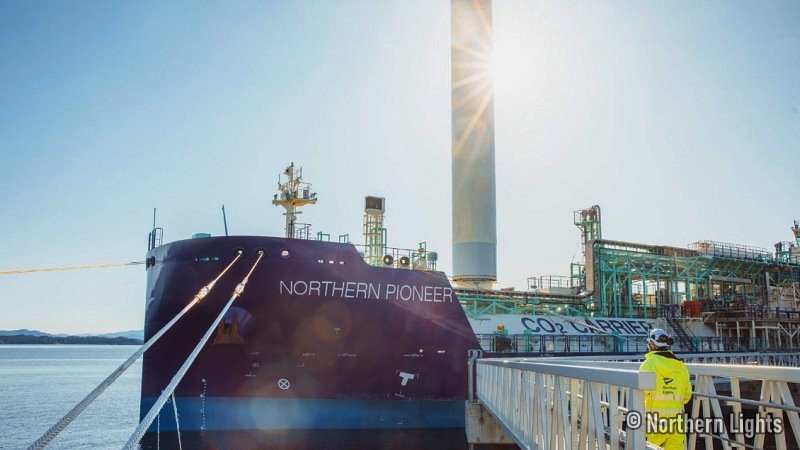
Bergen, Norway | December 08, 2025 – In a move that establishes a new standard for the global Carbon Capture and Storage (CCS) industry, Northern Lights JV has officially issued its first-ever storage certificates for CO₂ permanently sequestered in the Aurora reservoir.
The issuance marks a critical transition from pilot project to a verified commercial service, providing industrial emitters with the “proof of storage” necessary to navigate both compliance and voluntary carbon markets.
Verifying the Value Chain: The Role of Storage Certificates
The first set of certificates documents the successful transport and storage of CO₂ captured at the Heidelberg Materials cement factory in Brevik. These certificates are not merely receipts; they are comprehensive data sets that track the lifecycle of the carbon from the point of loading onto specialized ships to its final injection 2,600 meters below the North Sea.
Each certificate is tied to a specific ship cargo and includes:
- Net Volume: The precise quantity of CO₂ injected into the reservoir.
- Lifecycle Emissions: A transparent breakdown of emissions generated during the transport and storage process (e.g., shipping and facility operations).
- Digital Ledger Tracking: Data recorded via a dedicated digital system designed to ensure the integrity of carbon accounting.
“Credible carbon accounting is essential to the integrity of the emerging CCS industry,” said Tim Heijn, Managing Director of Northern Lights JV. “We are proud to be able to issue the first storage certificates for our customers, providing transparent and verifiable proof of emission storage.”
From Pipeline to Pore Space
The certification follows a successful operational ramp-up that began in August 2024. Captured CO₂ is liquefied at industrial sites and shipped to an onshore receiving terminal in western Norway. From there, it travels through a 100-kilometer pipeline before being injected into the Aurora offshore reservoir, located nearly 3 kilometers beneath the seabed.
The Northern Lights Monitoring, Reporting, and Verification (MRV) framework ensures that these volumes remain permanently trapped, satisfying the stringent requirements of international regulators and carbon markets.
A Growing Commercial Portfolio
While the first certificates were issued for Norwegian-captured carbon, Northern Lights is rapidly scaling its role as a cross-border decarbonization partner. The venture, which is a key component of the Norwegian Government’s Longship project, has already secured commercial agreements with several major European players:
| Partner | Country | Industry |
| Heidelberg Materials | Norway | Cement Production |
| Hafslund Celsio | Norway | Waste-to-Energy |
| Yara | Netherlands | Ammonia/Fertilizer |
| Ørsted | Denmark | Bioenergy/Renewables |
| Stockholm Exergi | Sweden | Bioenergy/Heating |
Implications for the Bunkering and Maritime Sector
For the bunkering and shipping industry, the success of Northern Lights provides a blueprint for the “L-CO₂” (Liquid CO₂) shipping market. As more industrial clusters look to export their emissions, the demand for specialized CO₂ carriers—and the specialized bunkering infrastructure to support them, is expected to surge.
The Northern Lights certificates provide the “missing link” in the carbon value chain, allowing shipowners and charterers to prove the environmental efficacy of their logistics operations.
About Northern Lights
Northern Lights offers CO₂ transport and storage as a service. Our mission is to enable the reduction and removal of industrial emissions in Europe. Liquefied CO₂ from capture sites is shipped to our onshore receiving terminal in western Norway, before being transported by pipeline for permanent storage in a reservoir 2,600 meters under the seabed. Northern Lights is the first company to offer commercial CCS services.
The first phase of Northern Lights is part of Longship, the Norwegian Government’s full-scale carbon capture and storage project. Northern Lights will transport and store CO₂ from two Norwegian industries: Heidelberg Materials’ cement factory in Brevik and the Hafslund Celsio waste-to-energy plant in Oslo. In addition, the Northern Lights JV has signed commercial agreements with Yara in the Netherlands, Ørsted in Denmark, and Stockholm Exergi in Sweden.
Source: Northern Lights JV