
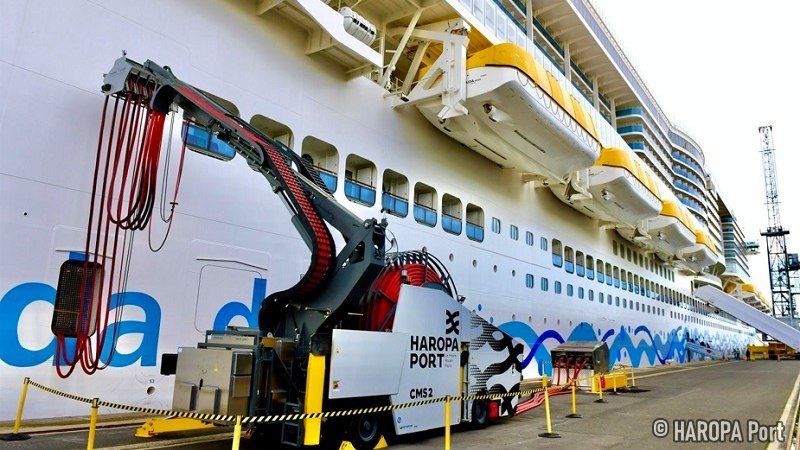
LE HAVRE, France | December 10, 2025 – HAROPA PORT has achieved a major milestone in the decarbonization of the “Seine Axis” as the next-generation cruise ship AIDAnova successfully connected to the port’s newly commissioned shore power system.
This first-of-its-kind operation at the Pierre Callet berth marks a decisive step in the port’s transition toward zero-emission calls, enabling large-scale vessels to switch off their engines and eliminate atmospheric emissions while at berth.
Technical Milestone: The RENAQ Project
This connection marks the operational expansion of the RENAQ project (Raccordement Électrique des Navires À Quai), a €32 million investment initiative led by HAROPA PORT in collaboration with the French State and the Normandy Region.
The infrastructure required to support a vessel of AIDAnova’s scale is significant:
- High-Voltage Connection: A 3 km underground network of 20,000-volt cables.
- Conversion Power: A 1,200 sq. m. facility dedicated to converting the public grid’s electricity to the specific frequency and voltage required by international cruise ships.
- Cable Management: The use of specialized mobile vehicles equipped with articulated arms to bridge the connection between the quay and the ship’s hull.
AIDAnova at Le Havre
- Vessel: AIDAnova (Carnival Corporation / AIDA Cruises).
- Location: Pierre Callet Berth, Port of Le Havre, France.
- Supplier: HAROPA PORT via the RENAQ Shore Power System.
- Environmental Impact: Complete elimination of CO2, SOx, NOx, and fine particle emissions during the port stay.
- Fleet Context: AIDAnova was the world’s first cruise ship designed to run entirely on LNG; it now integrates shore power to further minimize its carbon footprint.
Expanding the Green Corridor
The Port of Le Havre is positioning itself as a leader in Northern European sustainable tourism. Following the successful first-ever connection by the MSC Poesia in October 2025, the AIDAnova call confirms the system’s readiness for large-scale, next-generation vessels.
By 2026, HAROPA PORT plans to extend this electrification to the Roger Meunier and Joannès Couvert quays. Once fully operational across all three berths, the system is expected to prevent 15,000 to 20,000 tonnes of CO2 emissions annually, while significantly reducing engine noise and vibrations for the residents of Le Havre.
A Multi-Fuel Future
For AIDA Cruises, part of the Carnival Corporation, this stopover is part of a broader “Evolution” strategy. While AIDAnova utilized over 3,300 tons of bio-LNG in the first half of 2025 across other European ports, the ability to utilize shore power in Le Havre provides a vital secondary lever for reaching net-zero goals.
The successful operation was supported locally by shipping agent Humann & Taconet, highlighting the collaborative effort required to transition the marine fuel and energy landscape toward electricity.
HAROPA PORT is no longer just a place to buy VLSFO. It is becoming a multi-energy hub. By integrating Shore Power (Le Havre), Bio-LNG (Le Havre), and Green Hydrogen production (Rouen), HAROPA is ensuring that it remains a mandatory stop for the next generation of “Green” fleets like those operated by MSC, CMA CGM, and AIDA.
About Seine Axis
The Seine Axis (Axe Seine) is France’s premier multimodal logistics and industrial corridor, stretching approximately 350 kilometers from the English Channel to the heart of the Paris region. It is officially managed by HAROPA PORT, the unified entity that governs the ports of Le Havre, Rouen, and Paris.
Historically, the concept was famously summarized by Napoleon Bonaparte: “Paris, Rouen, and Le Havre are but one city, of which the Seine is the main street.”
About HAROPA Port
HAROPA PORT, France’s leading port system and the fifth-largest in Northern Europe, represents a strategic merger of the ports of Le Havre, Rouen, and Paris. By unifying these three hubs, HAROPA has created a seamless “Seine Axis” corridor that connects the Atlantic Ocean directly to the heart of the Paris consumer market, the largest in the country.
This integrated model allows the complex to handle over 100 million tonnes of maritime and river traffic annually, supporting everything from ultra-large container vessels at the deep-water terminal of Port 2000 in Le Havre to specialized cereal exports in Rouen and sustainable urban logistics in Paris.
The port continues to be a global pioneer in the maritime energy transition through its ambitious “New Fuels Valley” and decarbonization initiatives. A cornerstone of this strategy is the RENAQ project, which has successfully electrified the cruise quays in Le Havre, enabling next-generation vessels like the AIDAnova to eliminate emissions at berth.
Beyond shore power, HAROPA is aggressively developing infrastructure for green hydrogen, bio-LNG, and carbon capture (CCUS), positioning the Seine Axis as a premier green shipping corridor. These investments, supported by over €1.45 billion in funding, ensure that the port remains a competitive and sustainable gateway for international trade in the post-carbon era.
Source: HAROPA Port