
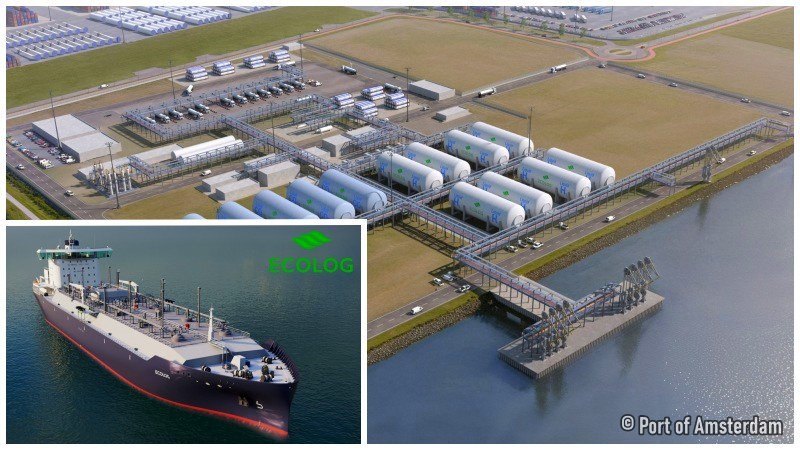
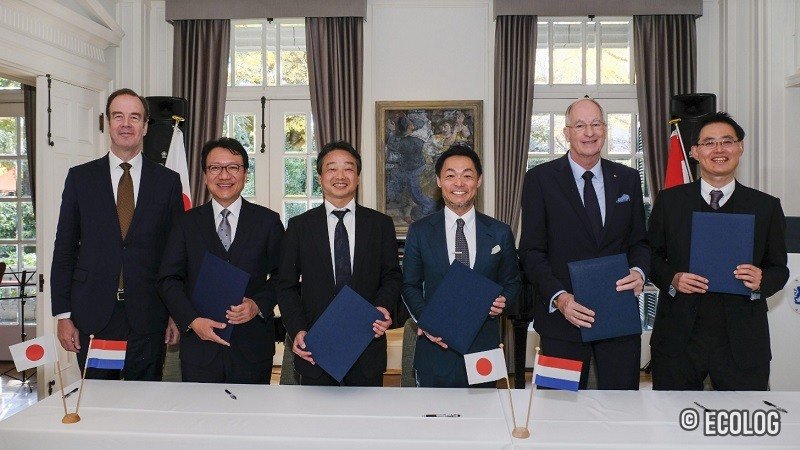
Amsterdam, Netherlands | December 18, 2025 – EcoLog has taken a significant step forward in the development of a liquid hydrogen (LH₂) import terminal at the Port of Amsterdam. Recently, the company signed a framework agreement in Tokyo with a consortium of technology partners to supply equipment for both the terminal and the specialised vessels that will transport the hydrogen. The signing ceremony was attended by H.E. Gilles Beschoor Plug, Dutch Ambassador to Japan.
Table of Contents
Consortium Partners and Scope
The consortium includes EBARA Corporation, Fukui Seisakusho, Kobe Steel, and TB Global Technologies, who will provide technical solutions for EcoLog’s LH₂ vessels as well as the planned terminal in Amsterdam. Together, the partners bring nearly 300 years of combined cryogenic engineering expertise, building on decades of LNG market experience to enable large-scale LH₂ deployment.
Key contributions include:
- EBARA Corporation – LH₂ pumps
- Fukui Seisakusho – LH₂ safety relief valves
- Kobe Steel – Heat exchangers for LH₂ regasification
- TB Global Technologies – Marine loading arms
These contributions complement EcoLog’s earlier partnership with Gas and Heat, announced at Gastech 2025, focusing on LH₂ storage and handling systems.
A Global First
EcoLog, in close cooperation with the Port of Amsterdam, is developing the terminal in the Afrikahaven area. It will be the world’s first liquid hydrogen import terminal of this scale, with an expected operational date around 2030.
Initial capacity will include:
- 200,000 tonnes of liquid hydrogen per year
- 1.8 million tonnes of liquid CO₂ per year
The terminal will enable pipelines, inland shipping, rail, and road transport, supplying hydrogen to industrial, mobility, shipping, and aviation sectors across the Netherlands, Germany, and the wider region.
Specialised Vessels and Equipment
Transporting liquid hydrogen safely and efficiently requires highly specialised vessels and equipment. The consortium agreement will develop and integrate critical technologies across vessels and terminal operations, including pumps, safety relief valves, heat exchangers, and marine loading arms.
Ellen Ruhotas, CEO of EcoLog, commented “This consortium, one of the world’s first industry-led initiatives, is a breakthrough for the development of global liquid hydrogen corridors, with Europe being the primary focus and the Netherlands as its gateway. By uniting world-class expertise across the LH₂ supply chain and building on LNG’s proven legacy, we are making liquid hydrogen a truly global clean energy solution. Today’s partnership ensures the full LH₂ supply chain is market ready.”
H.E. Ambassador Gilles Beschoor Plug added “The Netherlands is ideally positioned to be the hydrogen hub for North-West Europe. This partnership shows how Dutch and Japanese innovation can solve global energy challenges together.”
Strategic Importance of Green Hydrogen
The import of green hydrogen is essential for the European hydrogen economy and industrial decarbonisation. Domestic production in the Netherlands alone is insufficient, making international imports necessary. Earlier agreements with partners in Oman, Germany, and the Netherlands enable the import of LH₂, with the Amsterdam terminal serving as a strategic hub for North-West Europe.
About EcoLog
EcoLog is a global leader in midstream liquefied hydrogen (LH₂) and liquefied CO₂ solutions, specialising in the storage, handling, and transportation of cryogenic gases to accelerate the clean energy transition. With a commitment to innovation and sustainability, EcoLog develops scalable infrastructure, including LH₂ vessels and terminals, to bridge the gap between hydrogen production and demand centers worldwide. The company enables industries to unlock hydrogen’s potential as a reliable, efficient, and low-carbon fuel alternative.
About the Port of Amsterdam
The Port of Amsterdam is the fourth-largest seaport in Europe and plays a vital role in international trade and logistics. Strategically located in the North Sea Canal area, the port is a gateway for goods entering and leaving Europe and is home to more than 2,000 companies. With a strong commitment to sustainability and innovation, the port aims to be one of the cleanest and most efficient in the world.
Port of Amsterdam committed to facilitating the transition to sustainable shipping. Its Clean Shipping Vision is central to this goal, promoting the adoption of alternative fuels and zero-emission solutions throughout the maritime sector. As a Multi Fuel Port, it offers infrastructure and support for various alternative fuels, including LNG, methanol, biofuels, and hydrogen. The Port plays a pivotal role in enabling innovative fuel solutions, ensuring safety, and collaborating with stakeholders to promote zero-emission maritime operations.
Source Port of Amsterdam | Ecolog