
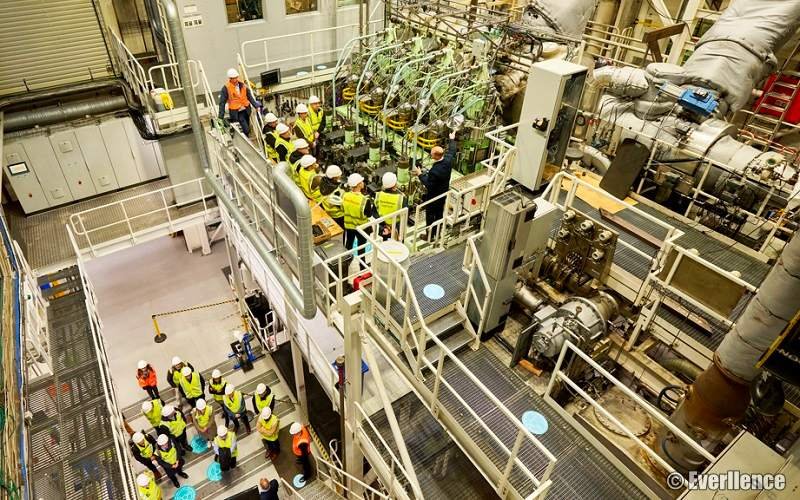
Copenhagen, Denmark | November 13, 2025 – In a significant step toward zero-carbon shipping, leading engine designer Everllence has officially unveiled its new dual-fuel two-stroke engine, the B&W ME-LGIA (Liquid Gas Injection Ammonia). The commercial debut was made at a two-day industry event in Copenhagen, gathering over 300 key representatives from across the maritime sector.
The ME-LGIA engine, which is now open for newbuilding orders, utilises the reliable Diesel principle and the company’s well-established Liquid Gas Injection concept, building on the success of its existing methanol-fuelled (ME-LGIM) and LPG-fuelled (ME-LGIP) units.
Engineered for Ammonia: Safety and Performance
Recognising the unique characteristics of ammonia as a marine fuel, Everllence has engineered the ME-LGIA with enhanced safety at its core. The new engine incorporates additional safety features developed specifically for ammonia, including:
- Containment systems
- Sensors
- Specialised system ventilation
- Double-walled piping
Dr. Uwe Lauber, CEO of Everllence, underscored the engine’s significance in the global energy transition:
“As the maritime industry’s leading engine designer, we are in a unique position to advance the green transition and know that bringing new fuels to market is not just innovation – it’s imperative for zero-carbon shipping. In this context, ammonia is a vital piece of the puzzle. The development of this engine is not just a technical achievement; it is another concrete step towards a climate-neutral future where the time to act is now.”
Project Timelines and Pilot Deployments
The first ME-LGIA engine is slated for delivery in the first quarter of 2026, with the bedding-in process scheduled for the fourth quarter of 2025.
Everllence is already advancing several high-profile pilot projects for the new technology, including:
- Two Very Large Ammonia Carriers (VLACs) for Eastern Pacific Shipping.
- Four engines for Höegh Autoliners Pure Car and Truck Carriers (PCTCs).
- An engine for a bulk carrier in Japan, which is currently on the MITSUI E&S testbed.
A Technological Milestone
Bjarne Foldager, Head of Two-Stroke Business at Everllence, hailed the new engine as a major achievement, confirming the rigorous development process:
“This ammonia engine is truly a technological milestone. It is the result of over 150,000 hours of collective work and represents a significant financial investment on our part. Since two-stroke engine testing on ammonia started in July 2023, we have carried out over 800 tests – both here in Copenhagen and at MITSUI E&S in Japan.”
Foldager further emphasised the commitment to safety: “All the way through, safety has been our first consideration and we have worked closely with the relevant authorities and classification societies to ensure that the technology meets all demands.“
Digital Connectivity for Optimisation
Beyond its dual-fuel capability, the ME-LGIA is designed for the modern, connected fleet. It enables a secure and reliable data flow from vessels for Everllence’s shore-based monitoring. This digital connectivity will:
- Leverage real-time engine and operational data.
- Improve performance and provide remote assistance.
- Help shipowners operate more efficiently and sustainably.
This integration highlights the significant role that data-driven insights will play in supporting the decarbonisation efforts as new fuels like ammonia enter the market.
Engine Availability
The initial commercial sales release of the ME-LGIA engine will feature a range of common bore sizes: G50, S50, S60, G60, G70, and G80. Everllence also confirmed that retrofit options for existing vessels will be made available at a later date.
Ammonia’s Promising Future as a Marine Fuel
Everllence highlighted several key characteristics that position ammonia (NH3) as a highly suitable fuel for deep-sea shipping decarbonisation:
- Emissions Profile: It is a promising carbon-free alternative, producing zero CO2, and low sulphur-oxide and particulate emissions. When produced from renewable sources (Green Ammonia), it is carbon-neutral.
- Compact Storage: Its relatively high volumetric energy-density allows for more compact fuel storage compared to hydrogen, which is critical for large ocean-going vessels. It can also be stored as a liquid at moderate pressures, simplifying bunkering.
- High Thermal-Efficiency: This reduces operational costs while maintaining power output.
- Established Supply Chains: As a widely produced chemical, ammonia benefits from existing global supply-chains. Production of Green and Blue ammonia is rapidly scaling up to meet future demand.
- Engine Suitability: Ammonia’s inherently slow combustion rate aligns well with the low piston speeds characteristic of two-stroke marine engines.
About Everllence
Everllence (formerly MAN Energy Solutions) is a global leader in decarbonization and propulsion systems for shipping, energy, and industry. Headquartered in Germany, the company’s portfolio spans advanced engine technology, climate-neutral fuel retrofits, carbon capture, hydrogen systems, and industrial heat pumps. Through its subsidiary Quest One, Everllence also supports green hydrogen production at scale. With 15,000 employees across more than 140 sites worldwide, Everllence’s service arm, Everllence PrimeServ, provides global after-sales support.
Source Everllence